Real Suboxone Tapering Success and How to Achieve It Painlessly
Understanding the Science: How to Taper Off Suboxone Without Withdrawal
To taper off Suboxone without withdrawal, use a hyperbolic, percentage-based schedule rather than fixed milligram cuts. Reduce your current dose by roughly 10% to 25% every 2 to 4 weeks, hold each new dose for at least 14 days, and switch to micro-dosing below 2 mg before stepping off. This approach keeps mu-opioid receptor occupancy changes gradual, which is the key to avoiding severe withdrawal symptoms.
To understand why this works, we have to look closely at buprenorphine pharmacology. Buprenorphine is a partial mu-opioid agonist characterized by exceptionally high receptor affinity and a long elimination half-life of 24 to 42 hours. Unlike full agonists such as oxycodone or heroin, buprenorphine binds tightly to receptors and activates them only partially, creating a ceiling effect that prevents intense euphoria and shields against respiratory depression.
When people try to stop taking their medication abruptly or rush through a rapid schedule, the results can be destabilizing. In fact, a 2017 systematic review in the Journal of Addiction Medicine highlighted that longer taper durations consistently produce improved completion rates, while rapid tapers lasting under one month show outcomes statistically no better than abrupt cessation. Furthermore, extensive research on buprenorphine receptor occupancy demonstrates that the medication does not leave the brain’s receptors in a straight, linear line. Understanding this curve is the cornerstone of our suboxone withdrawal taper complete guide.
Hyperbolic Receptor Occupancy and the Low-Dose Challenge
The primary reason patients struggle when coming off buprenorphine is the hyperbolic relationship between daily milligram dosage and mu-opioid receptor occupancy.
At higher therapeutic doses (16 mg to 24 mg daily), buprenorphine saturates approximately 80% to 95% of your brain’s mu-opioid receptors. If you reduce your dose from 16 mg to 8 mg, receptor occupancy only drops from around 85% to roughly 75%. That massive 8 mg reduction only frees up about 10% of your receptors, which is why early dose reductions often feel surprisingly easy.
However, the curve steepens dramatically at the lower end:
- At 4 mg, receptor occupancy sits near 50% to 60%.
- At 2 mg, receptor occupancy drops sharply to roughly 30% to 40%.
- At 1 mg, occupancy falls below 20%.
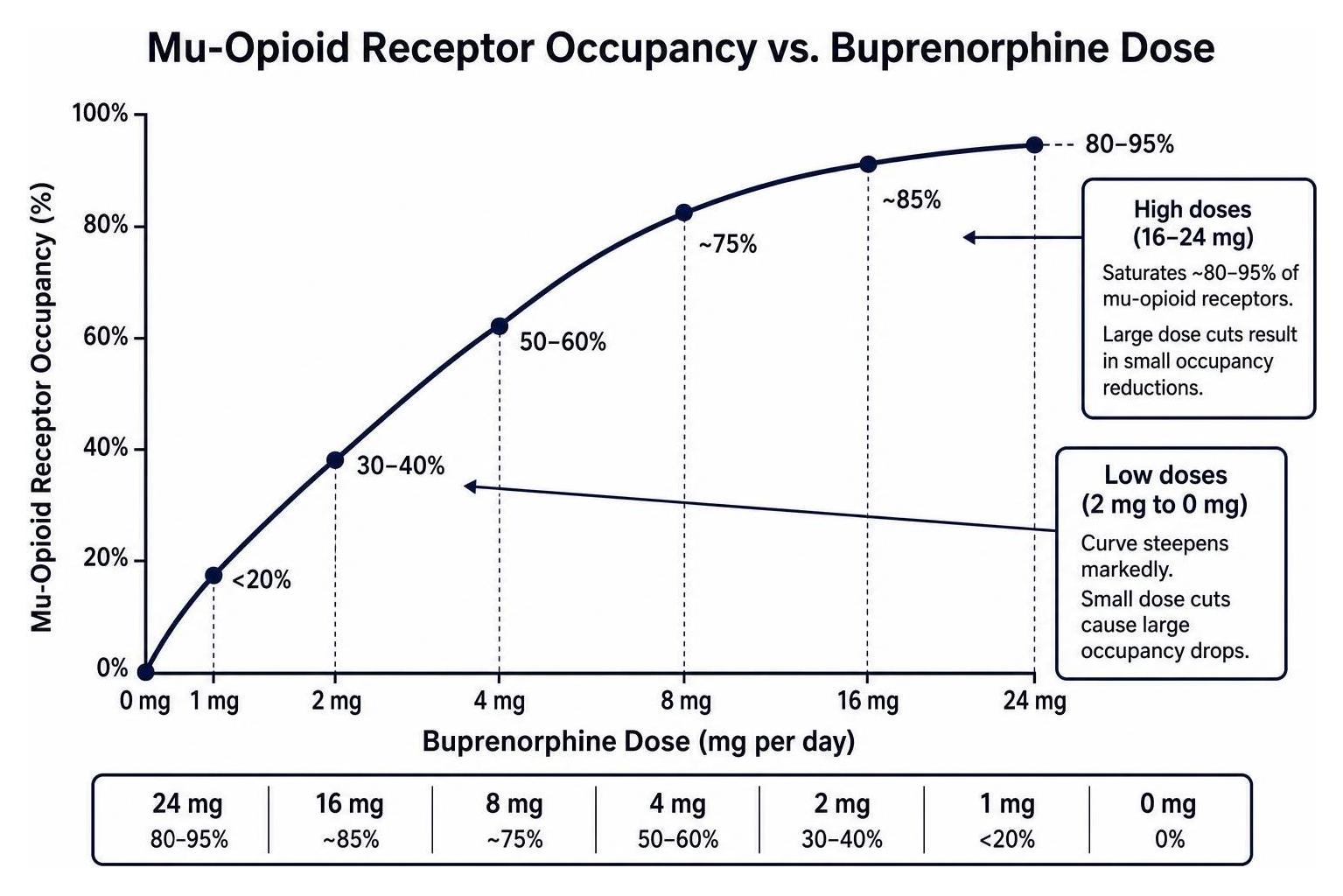
Between 2 mg and zero, every fraction of a milligram represents a massive physiological shift. Dropping from 2 mg directly to zero rips away nearly 40% of your total receptor coverage overnight. That sudden drop triggers acute autonomic distress, insomnia, and intense cravings.
Why Linear Dose Cuts Trigger Unnecessary Withdrawal
Standard linear reductions (such as cutting 2 mg every two weeks regardless of your current dose) fail because they treat every milligram equally. Cutting 2 mg from a 16 mg baseline is a modest 12.5% reduction. But cutting 2 mg from a 4 mg baseline is a punishing 50% drop, and dropping from 2 mg to 0 mg is a 100% drop in active medication.
Modern deprescribing guidelines—including frameworks established by the Maudsley Deprescribing Guidelines—recommend hyperbolic tapering. Instead of fixed milligram cuts, hyperbolic tapering calculates each reduction as a percentage (typically 10% to 20%) of your current dose. This ensures that the drop in actual mu-opioid receptor occupancy remains smooth and constant, protecting your neurochemistry and keeping severe withdrawal symptoms at bay.
Designing an Evidence-Based Hyperbolic Taper Schedule
A successful taper requires patience, structure, and clinical oversight. In our clinical experience across Tennessee and Virginia, a complete hyperbolic taper from a moderate dose (8 mg to 16 mg) to zero typically takes between 6 and 14 months. The final 2 mg alone often takes as long as the entire upper portion of the taper combined.
Here is how a linear approach compares to an evidence-based hyperbolic strategy:
| Taper Stage | Linear Taper Model (High Risk) | Hyperbolic Taper Model (Evidence-Based) | Physiological Impact (Receptor Occupancy) |
|---|---|---|---|
| High Dose (16 mg to 8 mg) | Drop 4 mg every 1–2 weeks | Reduce by 2 mg every 2–4 weeks (12.5%–25% cuts) | Occupancy drops gently from ~85% to ~75% |
| Mid Dose (8 mg to 2 mg) | Drop 2 mg every 1–2 weeks | Reduce by 1 mg to 0.5 mg every 2–4 weeks | Occupancy drops progressively from ~75% to ~40% |
| Low Dose (2 mg to 0.5 mg) | Drop 1 mg every week | Reduce by 0.25 mg to 0.5 mg every 3–4 weeks | Prevents steep receptor vacancy spikes |
| Micro-Dose (0.5 mg to 0 mg) | Jump to zero from 1 mg or 2 mg | Reduce by 0.125 mg to 0.0625 mg every 3–6 weeks | Allows gradual neurochemical restoration |
| Total Expected Timeline | 4 to 8 weeks (high relapse rate) | 6 to 14+ months (individualized pace) | Smooth biological transition |
When selecting structured buprenorphine tapering schedules, your plan should be tailored to your work life, support systems, and personal biological response.
Clinical Guidelines on How to Taper Off Suboxone Without Withdrawal from High Doses
During the early phase (16 mg down to 8 mg), dose reductions can occur in steady increments because your receptors remain mostly saturated.
- Calculate percentage reductions: Aim for cuts of 15% to 25% of your baseline dose every 2 to 4 weeks. For example, moving from 16 mg to 12 mg, and then from 12 mg to 8 mg.
- Respect the elimination half-life: Because buprenorphine has a half-life of up to 42 hours, you will not feel the true effect of a dose reduction on day one. Symptoms typically emerge between 24 and 72 hours post-reduction and peak around day 4 to 6.
- Hold before advancing: Always hold at your new dose for a minimum of 14 days to allow plasma levels and neuroreceptors to achieve biological equilibrium before making your next cut.
Micro-Dosing Below 2 mg: How to Taper Off Suboxone Without Withdrawal in the Final Phase
Once you cross below the 2 mg threshold, the game changes completely. Fixed milligram cuts must stop, and micro-reductions begin.
To taper smoothly below 2 mg:
- Target small decrements: Reduce by 0.25 mg down to 0.125 mg (or smaller) every 3 to 6 weeks.
- Precise film division: If using sublingual films, use sharp, sterile medical shears to cut your films into precise quarters or eighths over a clean, dry surface.
- Compounded formulations: In cases where cutting films becomes too imprecise, working with a specialized compounding pharmacy to create precise sublingual troches or volumetric liquid formulations ensures exact micro-dosing.
- The final step-off: Never jump from 1 mg or 2 mg. We encourage patients to step off only after stabilizing at a micro-dose between 0.125 mg and 0.0625 mg daily (or every other day).
Managing Symptoms and Comfort Medications During Dose Reductions
Even with a well-designed taper, minor symptoms can appear as your brain adapts to lower opioid receptor stimulation. Understanding what to expect helps you separate manageable adjustments from true destabilization. Referencing a validated suboxone withdrawal symptoms list helps you track your journey objectively.

Prescribed Comfort Medications for Autonomic Relief
Your medical provider can prescribe targeted, non-opioid medications before you make a dose reduction to handle temporary physical discomfort:
| Medication | Primary Target Symptoms | Mechanism of Action | Clinical Role |
|---|---|---|---|
| Clonidine | Sweating, chills, rapid heart rate, anxiety | Alpha-2 adrenergic agonist | Suppresses autonomic nervous system hyperactivity |
| Gabapentin | Restless leg syndrome (RLS), nerve pain, sleep disruption | Voltage-gated calcium channel modulator | Calms overactive central nervous system pathways |
| Hydroxyzine | Acute anxiety, restlessness, nausea | First-generation antihistamine (H1 inverse agonist) | Provides non-habit-forming sedative and calming relief |
| Ondansetron | Gastrointestinal upset, nausea | 5-HT3 receptor antagonist | Controls nausea without causing sedation |
| Trazodone | Rebound insomnia, disrupted sleep architecture | Serotonin antagonist and reuptake inhibitor (SARI) | Restores restorative sleep patterns during low-dose adjustments |
Working with an experienced provider ensures you receive evidence-based medications for suboxone withdrawal tailored to your specific symptoms.
If you are looking for compassionate, medically supervised care in Tennessee or Virginia, Make an Appointment to Treat Addiction Please don’t hesitate. Make an appointment today.
Behavioral Support, Nutrition, and Lifestyle Strategies
Medication is only one part of the puzzle. Supporting your body and mind with healthy habits makes a significant difference:
- Consistent Sleep Hygiene: Keep a strict sleep schedule, eliminate blue light an hour before bed, and keep your bedroom cool to combat nighttime temperature fluctuations.
- Physical Movement: Moderate daily exercise—such as walking, swimming, or light resistance training—stimulates natural endorphin and dopamine production, helping relieve restless legs.
- Strategic Nutrition and Hydration: Drink plenty of water and electrolytes. Eat whole, nutrient-dense meals rich in protein, complex carbohydrates, and magnesium to support muscle relaxation and steady blood sugar.
- Cognitive Behavioral Techniques (CBT): Practice deep breathing and grounding exercises when mild anxiety surfaces. Remind yourself that mild physical adjustments are signs of neurochemical healing, not an emergency.
Recognizing When to Pause, Slow Down, or Maintain Your Dose
Tapering is not a race. Setting an artificial deadline is one of the most common reasons tapers fail. Research shows that discontinuing buprenorphine is associated with a three-fold increase in overdose death risk, and a 2016 study of over 60,000 patients found that more than half relapsed within the first month of unmanaged cessation. Taking your time saves lives.
Before initiating any dose reduction, verify that you meet these key stability indicators:
- Stable housing, employment, and daily routines
- Absence of unmanaged cravings or drug-seeking thoughts
- At least 12 to 24 months of continuous, stable maintenance therapy
- An active, reliable support system (counselors, recovery groups, or supportive family)
- Absence of major acute life stressors (e.g., job changes, divorce, moves)
Before deciding to taper, it helps to understand the pros and cons of staying on suboxone long term with your physician.
The Symptom-Guided Pause and Step-Back Rule
A successful taper follows symptoms, not a rigid calendar. We teach our patients the Pause and Step-Back Rule:
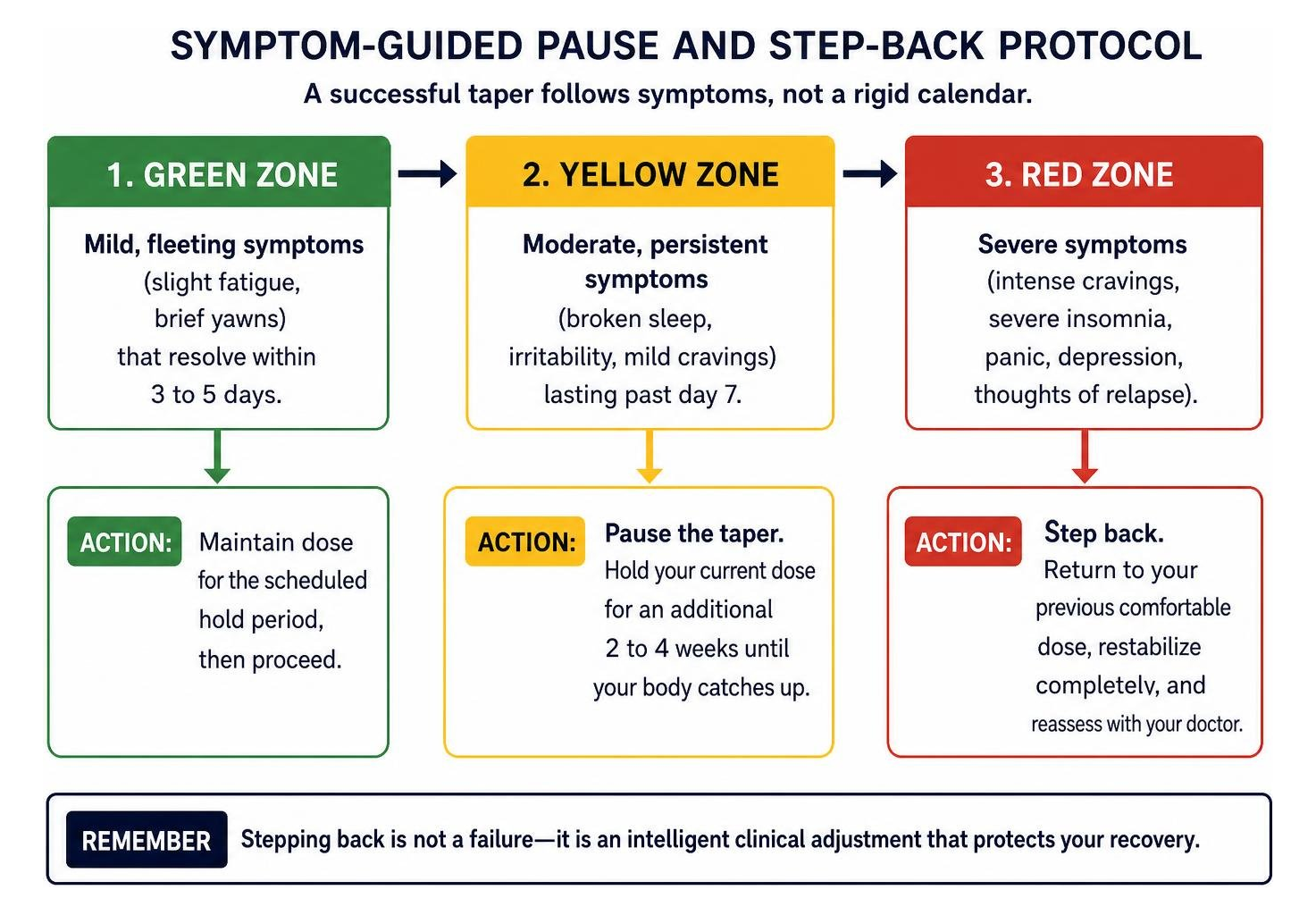
- The Green Zone: Mild, fleeting symptoms (slight fatigue, brief yawns) that resolve within 3 to 5 days. Action: Maintain dose for the scheduled hold period, then proceed.
- The Yellow Zone: Moderate, persistent symptoms (broken sleep, irritability, mild cravings) lasting past day 7. Action: Pause the taper. Hold your current dose for an additional 2 to 4 weeks until your body catches up.
- The Red Zone: Severe symptoms (intense cravings, severe insomnia, panic, depression, thoughts of relapse). Action: Step back. Return to your previous comfortable dose, restabilize completely, and reassess with your doctor.
Stepping back is not a failure—it is an intelligent clinical adjustment that protects your recovery.
Low-Dose Long-Term Maintenance vs. Discontinuation
There is zero shame in long-term maintenance. Many people ask, how long should I stay on suboxone, wondering if they must eventually reach zero.
Opioid use disorder is a chronic medical condition, much like type 1 diabetes or hypertension. If you find that stabilizing at a low daily dose (such as 1 mg or 2 mg) keeps your cravings quiet and your life stable, staying on that maintenance dose indefinitely is a completely valid, life-saving clinical outcome.
Navigating Post-Acute Withdrawal Syndrome (PAWS) and Long-Term Recovery
Once you take your final micro-dose, your recovery journey enters a new phase. While acute physical symptoms from a hyperbolic taper are minimal, your brain’s natural endorphin system requires time to resume full independent production.
Timeline and Psychological Symptoms of PAWS
Post-Acute Withdrawal Syndrome (PAWS) reflects the time it takes for your nervous system to recalibrate after opioid dependence. Understanding the suboxone withdrawal duration helps set realistic expectations:
- Weeks 1 to 4: Mild physical lethargy, temperature sensitivity, and disrupted sleep patterns may linger as the last traces of buprenorphine clear your tissues.
- Months 2 to 6: Psychological symptoms such as low energy, emotional blunting (anhedonia), mild anxiety waves, and reduced stress tolerance can occasionally appear in waves.
- Months 6 to 12: PAWS symptoms become less frequent and shorter in duration. Natural dopamine and endorphin pathways steadily recover.
Relapse Prevention and Ongoing Support Systems
Long-term success after tapering depends on strong recovery foundations:
- Individual and Group Counseling: Continue weekly or bi-weekly behavioral therapy to process underlying emotions and reinforce healthy coping habits.
- Trigger Management: Keep a written relapse prevention plan that identifies personal emotional, social, and environmental triggers, along with clear steps to take if cravings strike.
- Peer Connection: Stay engaged with recovery communities, 12-step programs, or SMART Recovery groups where you can share openly without fear of judgment.
- Open Medical Access: Maintain an active relationship with your addiction medicine provider so you can reach out right away if life becomes overwhelming.
Frequently Asked Questions About Suboxone Tapering
How long does a complete hyperbolic Suboxone taper take?
A clinically sound hyperbolic taper from a standard starting dose (8 mg to 16 mg) typically takes between 6 and 14 months. Patients tapering from higher doses or those who are sensitive to dose reductions may extend their taper to 18 months or longer. Pacing should always be guided by your symptoms rather than an arbitrary calendar deadline.
Can I cut Suboxone films or switch to liquid formulations to taper?
Yes. Sublingual films can be precisely cut using clean, small scissors to achieve fractional doses (such as 0.5 mg, 0.25 mg, or 0.125 mg). For ultra-low micro-dosing below 0.25 mg, your provider can also coordinate with a specialized compounding pharmacy to prescribe sublingual liquid drops or specialized micro-dose troches to ensure consistent dosing.
What should I do if withdrawal symptoms become unmanageable during a taper?
If withdrawal symptoms, insomnia, or cravings threaten your emotional well-being or sobriety, enact the step-back rule immediately. Increase your dose back to the last level where you felt stable, hold there for several weeks, and contact your telemedicine provider. You can always resume your taper at a slower pace and with smaller percentage drops once you feel fully balanced again.
Conclusion
Tapering off buprenorphine does not have to be a painful or destabilizing process. By respecting the medication’s hyperbolic receptor kinetics, calculating reductions as percentages rather than fixed milligram amounts, using comfort medications, and prioritizing micro-dosing below 2 mg, you can smoothly step down while keeping your recovery safe.
At National Addiction Specialists, we provide confidential, personalized, telemedicine-based addiction treatment and deprescribing care across Tennessee (including Brentwood) and Virginia (including Virginia Beach). We accept Medicaid and Medicare, allowing you to access board-certified medical guidance and custom taper plans from the comfort and privacy of your home.
Learn more about how to taper off suboxone safely with expert clinical support.
Suboxone® and Subutex® are a registered trademark of Indivior UK Limited. Any mention and reference of Suboxone® and Subutex® in this website is for informational purposes only and is not an endorsement or sponsorship by Indivior UK Limited.
This article was medically reviewed by: Chad Elkin, MD, DFASAM is a board-certified addiction medicine physician, founder, and Chief Medical Officer of National Addiction Specialists, dedicated to treating substance use disorders. A Distinguished Fellow of the American Society of Addiction Medicine (ASAM), Dr Elkin currently serves as President of the Tennessee Society of Addiction Medicine (TNSAM) and has held various leadership roles within the organization. Dr Elkin chairs ASAM’s Health Technology Subcommittee and is an active member of its Practice Management and Regulatory Affairs Committee, State Advocacy and Legislative Affairs Committee, and other committees. He also serves on the planning committee for the Vanderbilt Mid-South Addiction Conference. Committed to advancing evidence-based policy, Dr Elkin is Chairman of the Tennessee Association of Alcohol, Drug, & Other Addiction Services (TAADAS) Addiction Medicine Council, which collaborates with the TN Department of Mental Health & Substance Abuse Services (TDMHSAS). He has contributed to numerous local, state, and national task forces, helping develop professional guidelines, policies, and laws that align with best practices in addiction medicine. His work focuses on reducing addiction-related harm, combating stigma, and ensuring access to effective treatment.Passionate about the field of addiction medicine, he remains dedicated to shaping policy and enhancing patient care.