Kratom Treatment: How National Addiction Specialists Helps You Recover from Kratom and 7-OH Dependence
Navigation Label: Kratom Treatment (or Kratom / 7-OH Treatment)
Suggested Slug: /kratom-treatment/ (refresh existing) or /kratom-addiction-treatment/
Kratom and 7-OH Treatment Starts With Safe, Private Medical Support
Kratom and 7-OH Treatment helps individuals safely overcome physical dependence on raw kratom leaf powder, commercial extracts, and concentrated 7-hydroxymitragynine (7-OH) products. National Addiction Specialists (NAS) provides confidential, outpatient addiction-medicine care from home. The safest next step is a comprehensive clinical assessment to evaluate your alkaloid intake, withdrawal symptoms, co-occurring health conditions, and personal recovery goals.
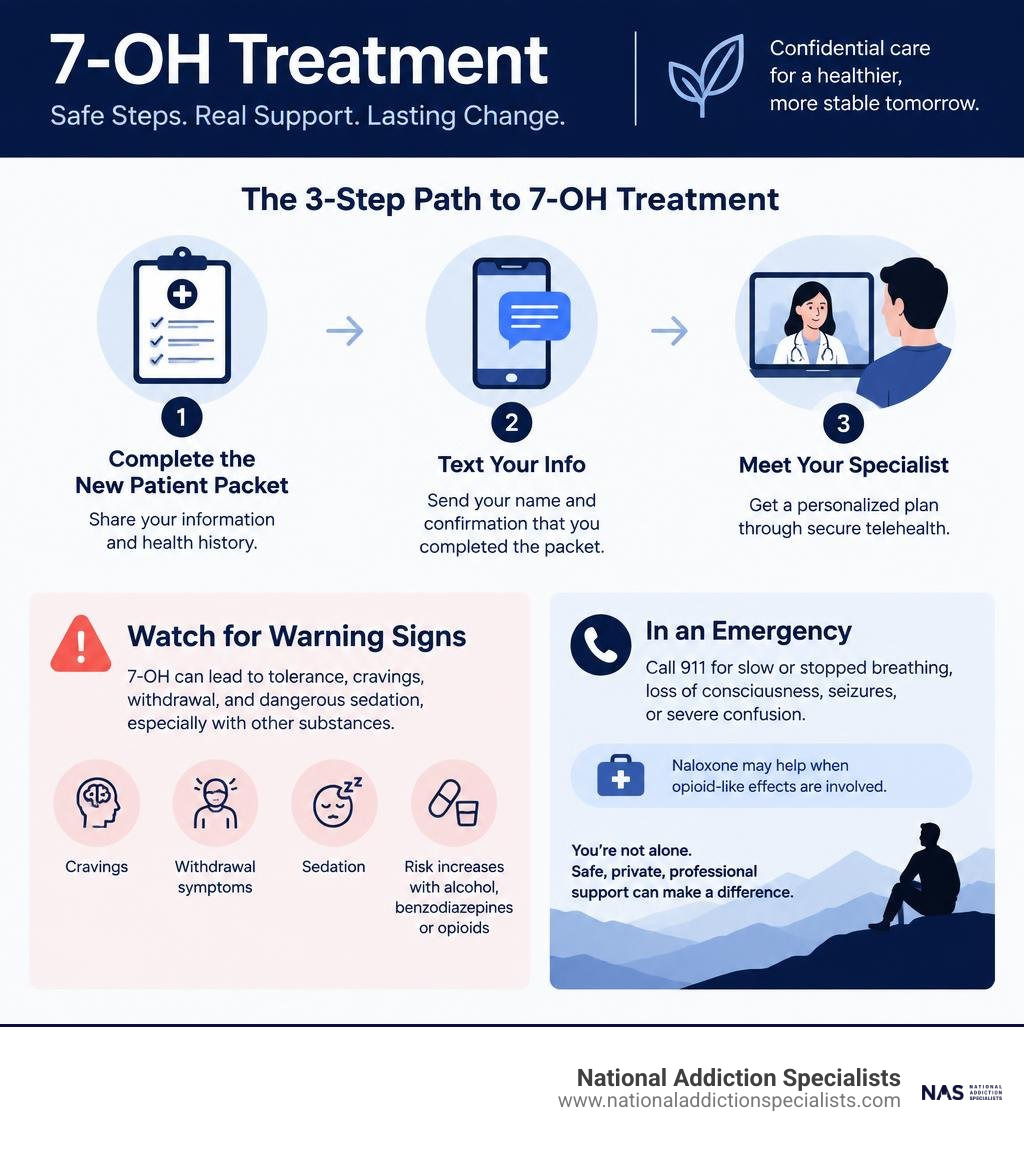
To begin care, complete the New Patient Packet and call or text 800-582-5822. After completing the packet online, text 800-582-5822 with your full name to ensure prompt clinician pairing.
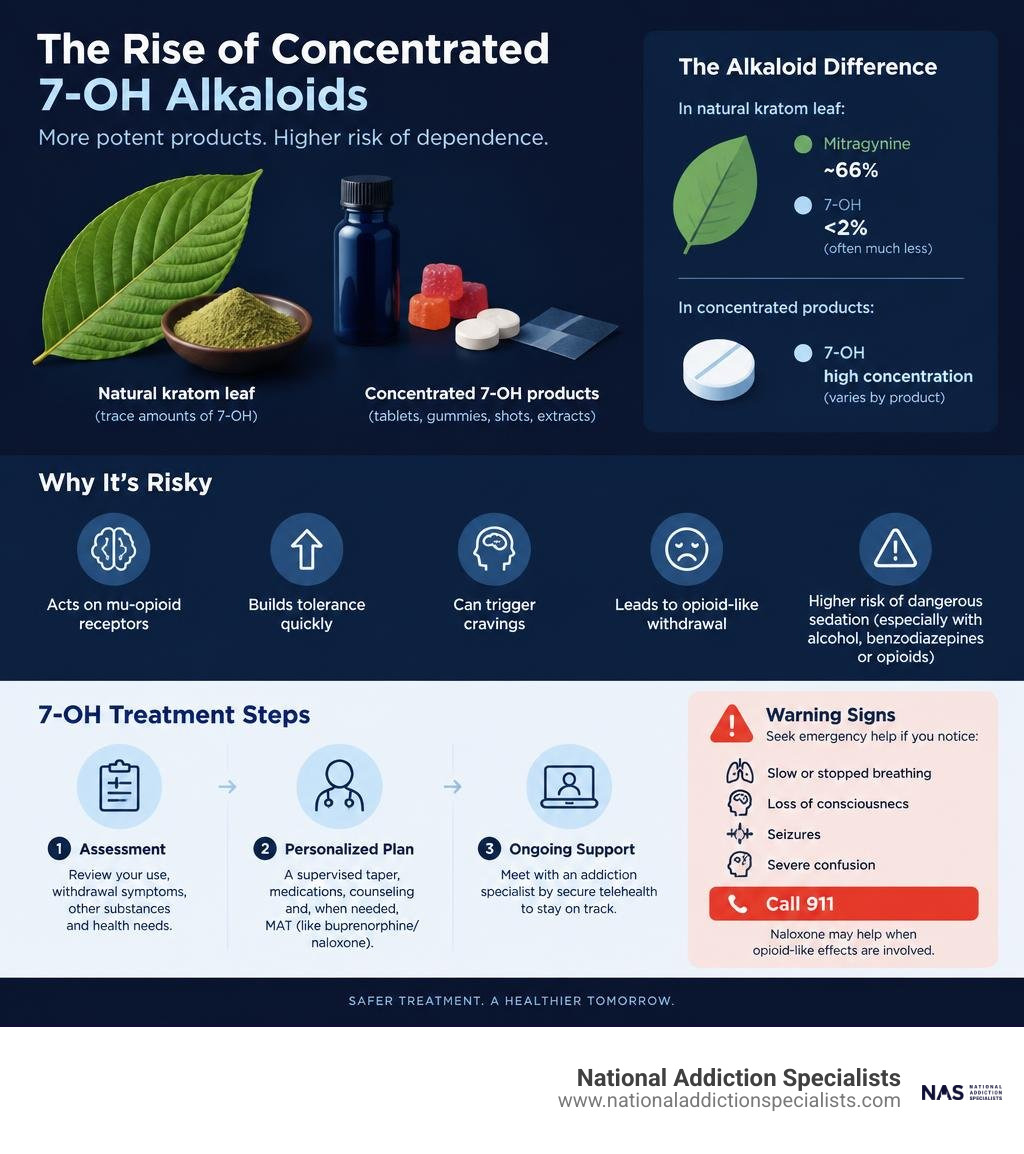
While traditional kratom leaf contains dozens of alkaloids with mitragynine as the primary component, modern extracts and semi-synthetic 7-OH tablets isolate and concentrate potent mu-opioid receptor agonists. Regular use of raw leaf, extracts, or 7-OH formulations can lead to rapid tolerance, cravings, opioid-like withdrawal, and sedation risks, especially when combined with other central nervous system depressants.
Do not try to manage severe withdrawal or overdose risks alone. Call 911 for slow or stopped breathing, loss of consciousness, seizures, or severe confusion. Naloxone may help when opioid-like toxicity is present.
I am Chad Elkin, MD, a board-certified addiction medicine physician and the founder and Chief Medical Officer of National Addiction Specialists. Our evidence-based kratom and 7-OH treatment programs provide accessible, nonjudgmental outpatient care across Tennessee, Virginia, and Texas.
Quick look at 7-OH Treatment:
Introduction
In recent years, the retail marketplace for botanical supplements has shifted dramatically. What began as traditional whole-leaf kratom powder consumed as brewed tea has evolved into an array of hyper-potent, chemically manipulated products. Chief among these is concentrated 7-hydroxymitragynine (7-OH).
While natural kratom contains dozens of distinct alkaloids, concentrated 7-OH isolates and magnifies the single compound primarily responsible for potent mu-opioid receptor activation. As these products have flooded convenience stores, smoke shops, and online storefronts, our clinical team has observed a steep rise in physical dependence, rapid tolerance, and severe withdrawal syndromes among individuals who believed they were taking a harmless herbal supplement.
According to national toxicology surveillance, poison control cases involving kratom-derived products escalated from under 200 cases in 2014 to over 1,600 by 2024, with roughly 40% of reports involving intentional misuse or adverse reactions to concentrated formulations. The rapid emergence of pure 7-OH chewable tablets, sublingual strips, and liquid shots demands dedicated clinical attention. At National Addiction Specialists, we provide comprehensive, outpatient medical care designed to stabilize the brain’s receptor systems, ease debilitating withdrawal symptoms, and establish lasting recovery.
Understanding 7-OH and the Risks of Concentrated Kratom Alkaloids
To understand why 7-OH creates rapid dependence, it helps to look at how it differs from traditional kratom. In raw Mitragyna speciosa leaf powder, the primary active compound is mitragynine, which makes up about 66% of the plant’s total alkaloids. In contrast, 7-hydroxymitragynine (7-OH) is found naturally only in trace amounts—typically less than 0.05% of the dried leaf.
Because extracting large amounts of natural 7-OH from leaves is difficult and expensive, manufacturers use chemical oxidation to convert standard mitragynine into concentrated 7-OH. A detailed 7-Hydroxymitragynine pharmacology overview shows that this chemical change significantly increases how strongly the substance binds to the brain’s opioid receptors.
| Characteristic | Raw Kratom Leaf Powder | Concentrated 7-OH Products |
|---|---|---|
| Primary Compound | Mitragynine (~66% of alkaloids) | Concentrated / semi-synthetic 7-OH |
| Natural 7-OH Amount | Tiny trace amounts (<0.05% by weight) | Purified doses (5 mg to over 30 mg per tablet) |
| Opioid Receptor Binding | Mild to moderate | Strong receptor binding |
| Potency Profile | Mild stimulation to moderate sedation | Much stronger than standard leaf; potent opioid-like effects |
| Tolerance Rate | Builds gradually over months of regular use | Can develop rapidly within days or weeks |
| Common Forms | Plain crushed leaf, capsules, brewed tea | Chewable tablets, sublingual strips, liquid shots |
What Is 7-Hydroxymitragynine (7-OH)?
7-Hydroxymitragynine is an active compound that binds directly to the brain’s mu-opioid receptors—the same receptors affected by classical opioids. Structurally, adding an oxygen-hydrogen (hydroxyl) group to the mitragynine molecule makes it bind far more tightly to these receptors.
In laboratory studies, 7-OH shows significantly higher potency than natural leaf alkaloids and even standard opioid reference medications. Because it activates these pathways so strongly, concentrated 7-OH quickly produces pain relief, sedation, strong cravings, and rapid physical dependence.
Why Concentrated 7-OH Poses Severe Health Risks
The main hazard of modern 7-OH products is their extreme concentration and unpredictable strength. When someone drinks raw leaf tea, the plant fiber and bitter taste naturally limit how much they can consume before developing nausea or dizziness. Concentrated 7-OH tablets bypass these natural limits entirely.
Commercial lab testing and investigative reports show that a single 7-OH tablet often delivers 15 mg to 30 mg or more of pure alkaloid—the chemical equivalent of hundreds of grams of raw leaf in one dose. Additionally, an FDA scientific assessment of 7-OH noted that concentrated 7-OH can suppress breathing in animal models with greater potency than morphine.
Because these products are sold in colorful, candy-like blister packs at retail counters, many consumers do not realize how potent they are until they experience severe withdrawal when trying to stop.
Signs of Dependence, Withdrawal Timelines, and Health Risks

Physical dependence occurs when the brain’s opioid and monoamine systems adjust their baseline functioning to the continuous presence of 7-OH. When the substance is stopped or reduced, the central nervous system rebounds into a state of acute hyperarousal. Anyone experiencing this cycle can review our comprehensive guide to kratom addiction treatment to understand how evidence-based care restores neurological balance.
Identifying 7-OH Dependence and Addiction
Recognizing the transition from casual experimentation to clinical dependence involves evaluating physical, behavioral, and psychological patterns:
- Dose Escalation: Needing progressively higher milligram amounts or switching from traditional powders to pure 7-OH tablets to avoid feeling sick.
- Dosing Around the Clock: Waking up in the middle of the night or early morning in a state of sweats, restlessness, or panic, requiring an immediate dose to sleep.
- Compulsive Financial Expenditure: Spending substantial sums at retail smoke shops to maintain a daily supply.
- Loss of Control: Repeatedly intending to taper down or stop, only to resume use when physical discomfort begins.
- Isolation and Secrecy: Hiding blister packs, empty bottles, or receipts from family members and loved ones.
Navigating the 7-OH Withdrawal Timeline
Because 7-OH is rapidly absorbed and cleared, its withdrawal syndrome tends to have a faster onset and sharper physical peak than whole-leaf kratom. Clinically, the timeline follows a predictable pattern, which is detailed further in our guide to drug withdrawal symptoms and timelines:
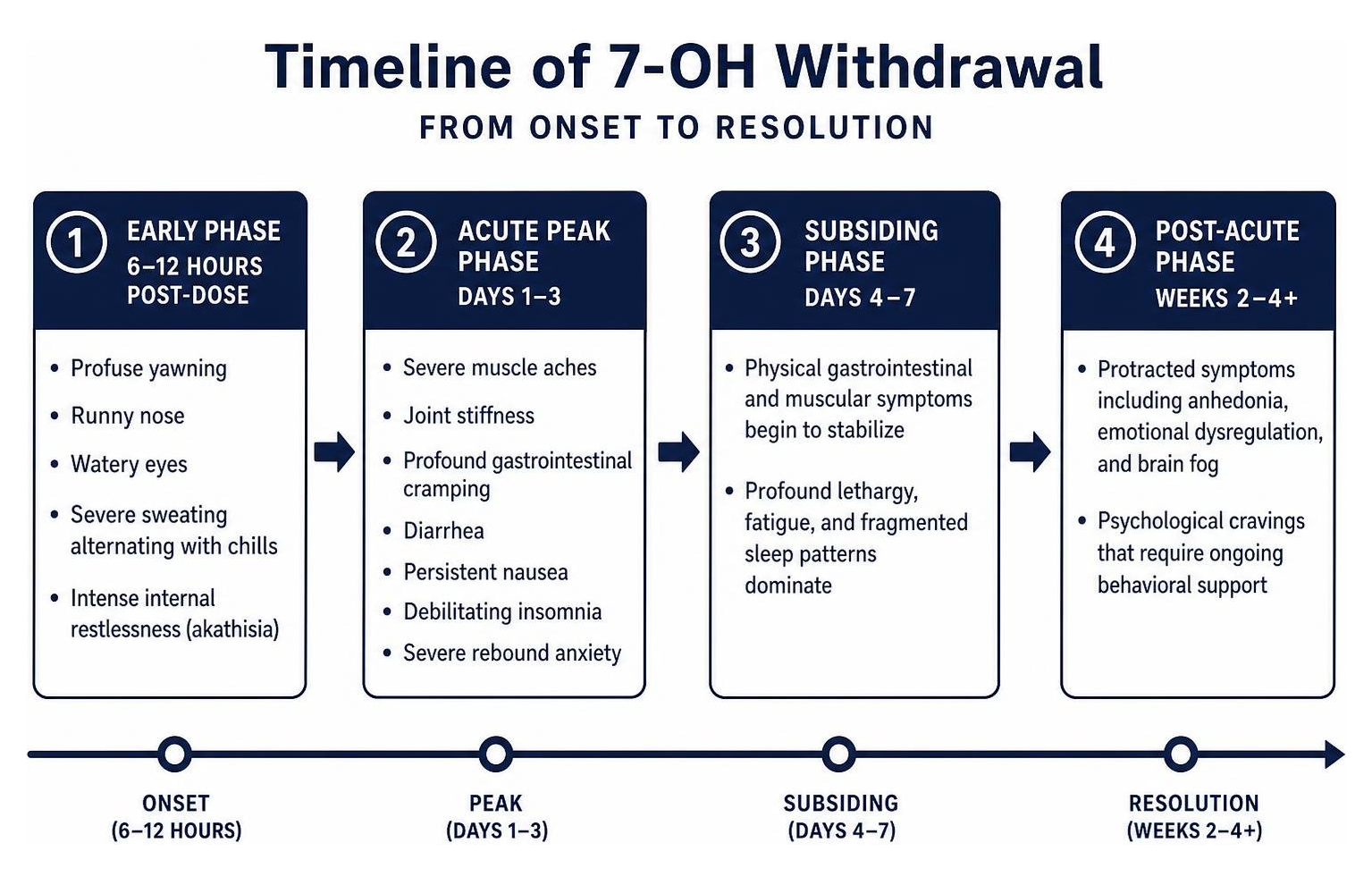
- Early Phase (6 to 12 Hours Post-Dose): Profuse yawning, rhinorrhea (runny nose), lacrimation (watery eyes), severe sweating alternating with chills, and intense internal restlessness (akathisia).
- Acute Peak Phase (Days 1 to 3): Severe muscle aches, joint stiffness, profound gastrointestinal cramping, diarrhea, persistent nausea, debilitating insomnia, and severe rebound anxiety.
- Subsiding Phase (Days 4 to 7): Physical gastrointestinal and muscular symptoms begin to stabilize; profound lethargy, fatigue, and fragmented sleep patterns dominate.
- Post-Acute Phase (Weeks 2 to 4+): Protracted symptoms including anhedonia, emotional dysregulation, brain fog, and psychological cravings that require ongoing behavioral support.
Overdose Risks and Dangerous Substance Interactions
While pure 7-OH exhibits partial agonism, combining it with other central nervous system depressants creates life-threatening toxicity. Mixing 7-OH with alcohol, prescription benzodiazepines, sleep aids, or classical opioids dramatically increases the risk of profound sedation, aspiration, and fatal respiratory depression.
Understanding how to manage opioid withdrawal symptoms safely means recognizing that medical oversight is critical during acute transitions. If an overdose is suspected, emergency services (911) must be called immediately, and naloxone (Narcan) should be administered without hesitation.
Clinical Approaches and the NAS Treatment Process
Treating kratom and 7-OH dependence requires an individualized medical strategy. Because kratom alkaloids act directly upon mu-opioid pathways, attempting cold-turkey withdrawal often leads to intense discomfort and high relapse rates. Board-certified clinicians evaluate your full history to deliver comprehensive using Suboxone for kratom dependence protocols and targeted comfort medications.
Make an Appointment to Treat Addiction Please don’t hesitate. Make an appointment today.
The Three-Step NAS Treatment Process
National Addiction Specialists guides patients through a structured, three-step outpatient pathway designed for safety and long-term recovery:
- Step 1: Get Started with the New Patient Packet Complete the New Patient Packet online to submit your medical history, kratom or 7-OH product use, and recovery needs. Once finished, text 800-582-5822 with your full name and a brief note confirming your packet is complete so our clinical team can review it promptly and assist with insurance verification.
- Step 2: Pair with Your Provider and Begin Treatment Meet one-on-one with a dedicated addiction medicine specialist via secure telemedicine video. Your clinician reviews your withdrawal timeline, co-occurring symptoms, and determines whether a medically supervised taper, supportive comfort medications, or medication-assisted treatment (such as buprenorphine/naloxone) is clinically indicated.
- Step 3: Stabilize and Stay in Recovery Achieve lasting neurological stability through continuous care. Your ongoing plan includes follow-up telemedicine visits, medical monitoring, medication management, and integrated behavioral therapy to address underlying triggers and prevent relapse.
Telehealth and Outpatient Medical Care
Through our specialized telehealth Suboxone treatment platform, patients access expert medical care entirely from home. Buprenorphine provides a partial mu-opioid agonist ceiling effect that eases acute withdrawal and suppresses cravings, while non-opioid comfort medications manage autonomic hyperactivity, insomnia, and gastrointestinal distress under direct physician oversight.
Supporting Loved Ones and Accessing Quality Care
Substance dependence affects entire families. Because kratom leaf and 7-OH products are frequently marketed as natural supplements or over-the-counter wellness aids, family members are often surprised when a loved one develops severe physical dependence.
Regulatory frameworks are evolving quickly. In Tennessee, following Matthew Davenport’s Law, individuals navigating the Tennessee kratom ban face legal restrictions on commercial kratom alongside health concerns. Federal agencies continue evaluating concentrated 7-OH formulations, emphasizing the need for structured medical support.
Guidance for Families and Loved Ones
If you suspect a loved one is struggling with kratom or 7-OH dependence, approach them with empathy and clear communication:
- Understand the Physiology: Recognize that kratom and 7-OH dependence is a physical medical condition driven by opioid-receptor neurochemistry, not a failure of willpower.
- Communicate Openly: Discuss observable symptoms—such as morning sweats, mood swings, or escalating retail expenditures—without judgment or confrontation.
- Establish Healthy Boundaries: Refrain from financing smoke shop purchases or unverified supplement orders.
- Connect with Medical Care: Encourage your loved one to consult a board-certified addiction practice that provides confidential telehealth assessments.
The National Addiction Specialists Advantage
National Addiction Specialists delivers high-quality, evidence-based addiction medicine through CARF-accredited program standards. We proudly serve patients across Tennessee, Virginia, and Texas, eliminating the barriers of travel and crowded waiting rooms.
We accept Medicare, Medicaid, and major commercial health insurance plans, ensuring that safe, medically supervised kratom and 7-OH recovery remains accessible from the privacy of home.
Frequently Asked Questions About 7-OH Treatment
Can Suboxone help manage 7-OH withdrawal and cravings?
Yes. Buprenorphine/naloxone (Suboxone) is frequently utilized off-label by board-certified addiction medicine specialists to manage moderate-to-severe 7-OH dependence. Because 7-OH operates primarily via mu-opioid receptor agonism, buprenorphine effectively binds to these sites, quelling acute withdrawal symptoms and reducing cravings while establishing neurological stability.
How long does acute 7-OH withdrawal typically last?
Acute physical withdrawal from concentrated 7-OH generally begins within 6 to 12 hours after the last dose, peaks in intensity between days 1 and 3, and begins to subside significantly by days 5 to 7. However, psychological symptoms such as anxiety, anhedonia, and sleep disturbances can persist for several weeks without structured medical and behavioral support.
Is professional medical detox necessary for 7-OH cessation?
While stopping 7-OH “cold turkey” is rarely life-threatening on its own, the severe physical and psychological discomfort frequently leads to rapid relapse or dangerous self-medication with alcohol and sedatives. A medically supervised outpatient detox or telehealth MAT program provides safety, comfort medications, and the stability needed for long-term recovery.
Conclusion
Overcoming dependence on kratom leaf, extracts, or concentrated 7-OH does not require enduring acute withdrawal alone or disrupting your work and family commitments for residential rehab. With modern addiction medicine and personalized telehealth care, lasting recovery is accessible directly from your home.
Start your recovery path in three simple steps:
- Complete the New Patient Packet.
- Text 800-582-5822 with your name to confirm completion.
- Pair with your provider to begin an individualized treatment plan across Tennessee, Virginia, and Texas through confidential medication-assisted treatment.
Suboxone® and Subutex® are a registered trademark of Indivior UK Limited. Any mention and reference of Suboxone® and Subutex® in this website is for informational purposes only and is not an endorsement or sponsorship by Indivior UK Limited.
This article was medically reviewed by: Chad Elkin, MD, DFASAM is a board-certified addiction medicine physician, founder, and Chief Medical Officer of National Addiction Specialists, dedicated to treating substance use disorders. A Distinguished Fellow of the American Society of Addiction Medicine (ASAM), Dr Elkin currently serves as President of the Tennessee Society of Addiction Medicine (TNSAM) and has held various leadership roles within the organization. Dr Elkin chairs ASAM’s Health Technology Subcommittee and is an active member of its Practice Management and Regulatory Affairs Committee, State Advocacy and Legislative Affairs Committee, and other committees. He also serves on the planning committee for the Vanderbilt Mid-South Addiction Conference. Committed to advancing evidence-based policy, Dr Elkin is Chairman of the Tennessee Association of Alcohol, Drug, & Other Addiction Services (TAADAS) Addiction Medicine Council, which collaborates with the TN Department of Mental Health & Substance Abuse Services (TDMHSAS). He has contributed to numerous local, state, and national task forces, helping develop professional guidelines, policies, and laws that align with best practices in addiction medicine. His work focuses on reducing addiction-related harm, combating stigma, and ensuring access to effective treatment.Passionate about the field of addiction medicine, he remains dedicated to shaping policy and enhancing patient care.