

Naltrexone vs Suboxone: Understanding Mechanism and Brain Chemistry
When evaluating evidence-based paths for recovery, understanding how medication-assisted treatment works in the central nervous system is essential. Opioid dependence alters the brain’s reward pathways by repeatedly activating mu-opioid receptors. Over time, the brain adjusts to this stimulation, leading to physical dependence, intense cravings, and severe withdrawal symptoms when the substance is stopped.
Both naltrexone and Suboxone target these same mu-opioid receptors, but they interact with them in fundamentally different ways. One acts as a physical shield that prevents any opioid from binding, while the other provides a controlled, stabilized level of activation to eliminate withdrawal without producing intoxication (NBK195158).
Comparing Naltrexone vs Suboxone Mechanisms in the Brain
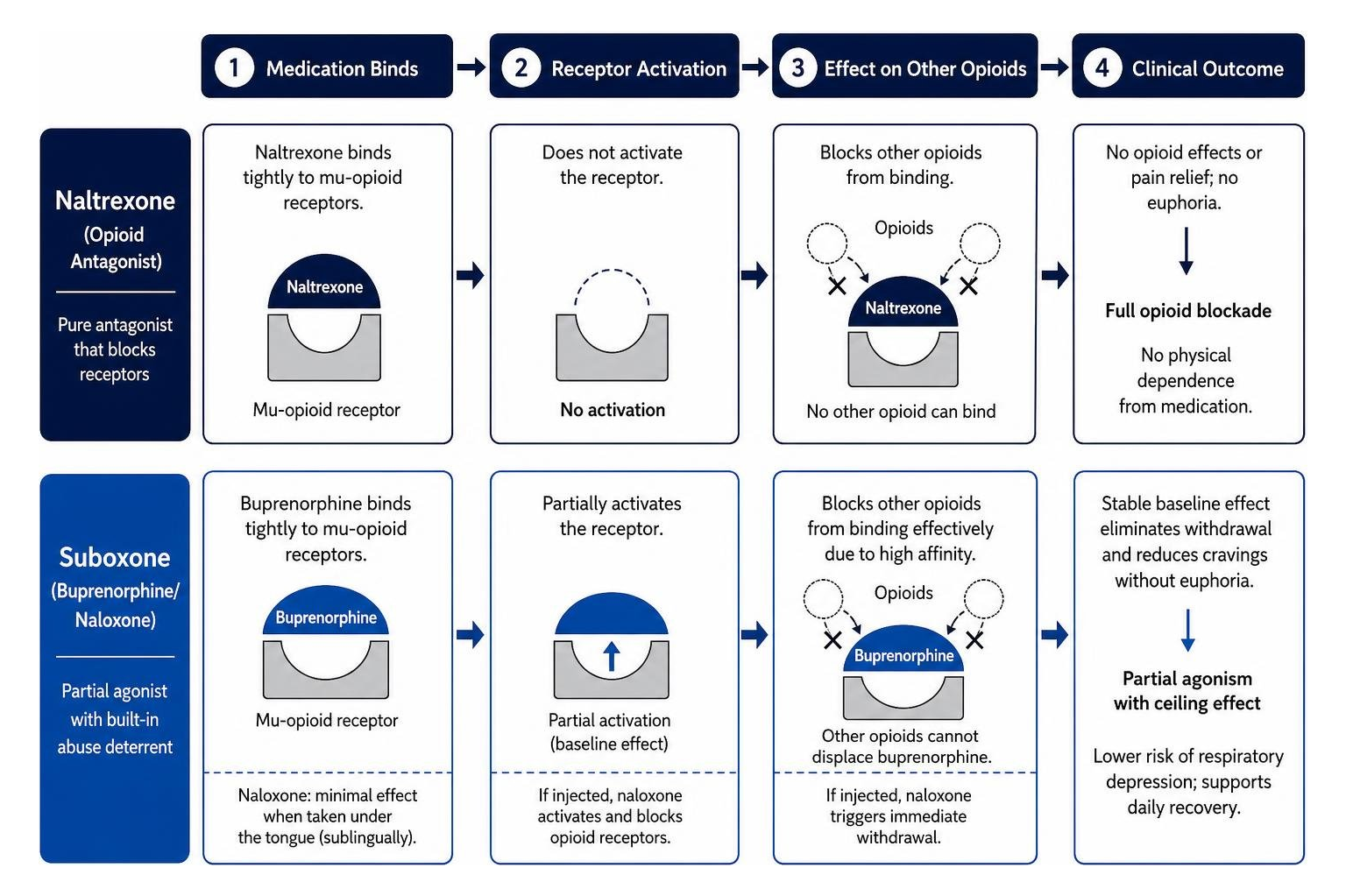
Naltrexone is classified pharmacologically as a pure opioid antagonist. Once inside the body, it attaches tightly to mu-opioid receptors without activating them. Think of it like placing a protective cap directly over an electrical outlet: it does not draw any power, but it completely prevents anything else from plugging in. Because naltrexone occupies these receptors with high affinity, any other opioid taken—such as oxycodone, heroin, or fentanyl—is physically blocked from binding. As a result, the individual experiences zero euphoric effects or pain relief from external opioids.
This mechanism makes Vivitrol treatment (extended-release injectable naltrexone) an appealing option for individuals who have already completed medical detoxification and desire complete opioid receptor blockade with no physical dependence on the medication itself.
Full Opioid Blockade vs Partial Agonism
In contrast, Suboxone relies on a very different pharmacologic mechanism known as partial agonism. Suboxone contains two active ingredients: buprenorphine and naloxone (NBK195158).
- Buprenorphine (Partial Agonist): Buprenorphine binds tightly to mu-opioid receptors and activates them, but only partially. This baseline activation satisfies the brain’s chemical dependence, extinguishing debilitating withdrawal symptoms and suppressing intense cravings. Buprenorphine exhibits a distinct “ceiling effect,” meaning that taking higher doses beyond a therapeutic threshold does not increase its opioid effects or cause dangerous respiratory depression.
- Naloxone (Antagonist Abuse Deterrent): Naloxone is included in the formulation specifically to deter misuse. When taken properly under the tongue (sublingually), naloxone has minimal bioavailability and does not block buprenorphine. However, if the medication is crushed and injected, naloxone activates rapidly, triggering immediate withdrawal.
This unique buprenorphine and naloxone combination creates a stable foundation that allows patients to focus on everyday recovery without the highs and crashes of full opioid agonists.
Administration Routes, Induction Protocols, and Practical Considerations
The practical realities of how a medication is administered, how often it must be taken, and how treatment begins play a major role in long-term success. A comprehensive overview of what Suboxone is illustrates why daily home dosing appeals to many patients, while others prefer the hands-off nature of a monthly clinic injection.
Monthly Vivitrol Injections vs Daily Sublingual Films
Extended-release naltrexone (Vivitrol) is administered as an intramuscular gluteal injection once every 28 to 30 days by a licensed healthcare professional. For individuals who struggle with daily medication routines or who prefer not to store medications at home, this monthly schedule provides complete peace of mind for roughly four weeks per dose.
Suboxone is formulated as a sublingual film or tablet that dissolves under the tongue once daily. Patients can store and self-administer Suboxone at home, which pairs seamlessly with outpatient telemedicine care.
| Feature | Vivitrol (XR-Naltrexone) | Suboxone (Buprenorphine/Naloxone) |
|---|---|---|
| Medication Class | Pure Opioid Antagonist | Partial Opioid Agonist / Antagonist |
| Administration Route | Intramuscular (IM) injection | Sublingual film or tablet |
| Dosing Frequency | Once every 28–30 days | Once daily |
| Where Administered | In-clinic by a healthcare provider | Self-administered at home |
| Controlled Substance | No (Non-scheduled) | Yes (Schedule III) |
| Induction Requirement | 7–14 days complete opioid abstinence | Mild-to-moderate withdrawal (COWS 8–12+) |
| Physical Dependence | None | Mild/Expected (managed tapering) |
Detoxification Timelines and Precipitated Withdrawal Risks
The induction protocol—how treatment actually starts—is often the decisive factor when choosing between these therapies.
Because naltrexone is a pure antagonist, starting it while any opioids remain in the body will immediately strip those opioids from the receptors, triggering acute, severe precipitated withdrawal. Therefore, patients must undergo a strict washout period of 7 to 10 days for short-acting opioids (such as oxycodone or heroin) and up to 14 days for long-acting opioids (such as methadone or illicit fentanyl) before receiving their first injection. For many individuals actively dealing with substance use disorder, enduring complete abstinence for over a week presents a formidable obstacle (Tofighi et al., 2019).
Suboxone induction is substantially faster. Because buprenorphine is a partial agonist, patients only need to be in mild-to-moderate withdrawal—typically scored using the Clinical Opiate Withdrawal Scale (COWS)—before initiating treatment. This usually requires waiting just 12 to 24 hours after short-acting opioids. For those later interested in switching maintenance therapies, learning about transitioning safely without withdrawal helps clarify how careful medical protocols prevent discomfort during clinical transitions.
If you are ready to take the first step toward lasting recovery, Make an Appointment to Treat Addiction Please don’t hesitate. Make an appointment today.
Comparative Effectiveness, Treatment Retention, and Daily Functioning
Evaluating medication performance requires looking at real-world data across clinical trials and public health outcomes, including retention, safety, and quality of life.
Real-World Retention: Naltrexone vs Suboxone Studies
Clinical studies demonstrate that both medications offer strong protective benefits against fatal overdose when patients stay on them. However, real-world retention rates tell a critical story.
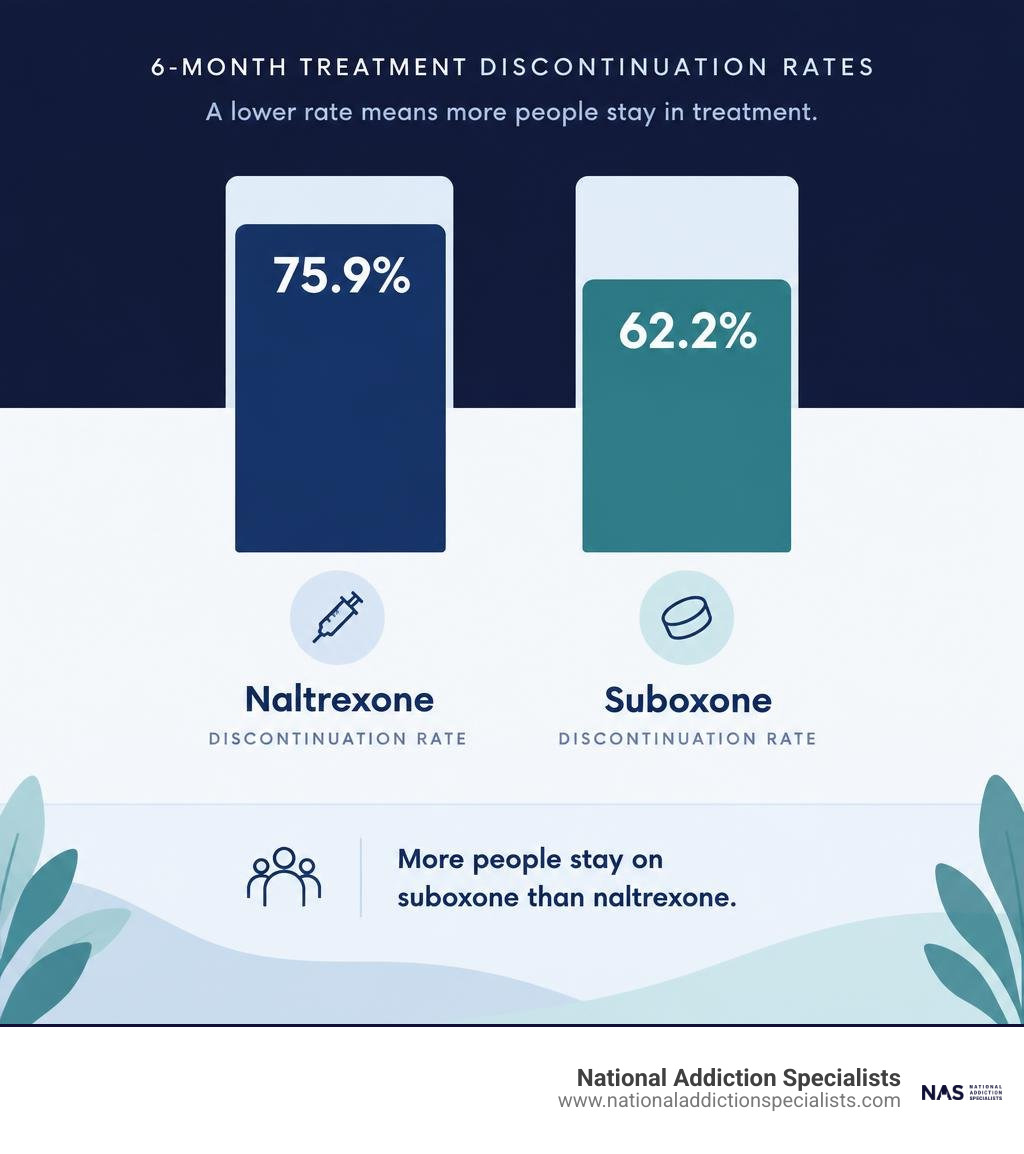
According to an extensive comparative effectiveness study of extended-release naltrexone and sublingual buprenorphine among Medicaid patients, 75.9% of patients who initiated extended-release naltrexone discontinued treatment or died within 6 months, compared to 62.2% of those initiating sublingual buprenorphine (Ross et al., 2024). While the adjusted 6-month risk of overdose or mortality was comparable between the two cohorts (3.9% for naltrexone vs. 3.3% for buprenorphine—a difference of just 0.5 percentage points), patients on sublingual buprenorphine consistently maintained treatment significantly longer (Ross et al., 2024).
Qualitative research also highlights that patient familiarity and perceived autonomy heavily influence retention (Tofighi et al., 2019). Many individuals report greater familiarity with buprenorphine’s ability to promptly alleviate cravings, whereas limited awareness of injectable naltrexone and the hurdle of pre-treatment detox lead to higher drop-out rates prior to induction (Tofighi et al., 2019).
Everyday Functioning, Fatigue, and Cognitive Health
Recovery extends beyond abstinence; it involves restoring day-to-day functional well-being, employment stability, and mental clarity:
- Energy and Fatigue: Systematic reviews show that patients receiving buprenorphine generally report less physical fatigue compared to untreated individuals and those receiving full-agonist maintenance such as methadone.
- Cognition and Motor Function: In broad systematic assessments of cognitive function, small subsets of patients on opioid agonist therapy show minor impairments in working memory and processing speed compared to healthy controls, but perform substantially better than during active illicit drug use.
- Driving and Road Safety: Studies note a slightly elevated risk of motor vehicle incidents for all opioid-based pharmacotherapies compared to non-users; patients are advised to use caution when starting or adjusting doses.
- Employment and Social Life: Research indicates that employment rates do not significantly differ between patients receiving buprenorphine, naltrexone, or non-medication psychosocial treatment across long-term follow-ups. Both pharmacotherapies offer a reliable chemical foundation that helps individuals regain family trust, maintain steady work, and rebuild daily routines.
How to Choose: Matching Patient Characteristics to the Right Medication
No single medication is universally superior; the best option depends on an individual’s medical history, co-occurring conditions, and personal goals. Reviewing comprehensive medication-assisted treatment options with an experienced clinician ensures treatment is tailored to your specific circumstances.
Navigating Co-Occurring Alcohol Use Disorder and Chronic Pain
- Co-Occurring Alcohol Use Disorder (AUD): Naltrexone is FDA-approved to treat both opioid use disorder and alcohol dependence. It works by blocking the dopamine release associated with alcohol consumption, reducing heavy drinking days and alcohol cravings. For patients struggling simultaneously with alcohol and opioids who can safely complete detoxification, naltrexone offers dual therapeutic coverage.
- Co-Occurring Chronic Pain: Suboxone is frequently the preferred choice for patients who live with chronic pain alongside opioid use disorder. Because buprenorphine is an active mu-opioid agonist, it provides continuous analgesic properties. In contrast, naltrexone blocks all opioid pain medications, making acute or chronic pain management much more complex.
- Employment and Licensing Requirements: Certain safety-sensitive professions, commercial driving roles, or specialized recovery programs prefer or require non-controlled substance maintenance. Because naltrexone is not a controlled substance and carries zero abuse potential, it is often favored in these specific environments.
Cost, Insurance Coverage, and Side Effect Profiles
Practical variables like prescription pricing, drug interactions, and tolerability also shape medication decisions.
| Practical Consideration | Naltrexone (Oral / Vivitrol) | Suboxone (Buprenorphine/Naloxone) |
|---|---|---|
| Common Side Effects | Nausea, headache, anxiety, insomnia, injection-site pain | Constipation, headache, mild nausea, sweating, insomnia |
| Primary Safety Monitoring | Hepatic (liver) function monitoring | Respiratory status with sedatives; oral dental hygiene |
| Drug Interactions | Interacts with ~364 medications (blocks all opioid analgesics) | Interacts with ~751 medications (sedatives/benzodiazepines risk) |
| Approximate Out-of-Pocket Cost | ~$98 per 100 oral tablets; Vivitrol injections vary by insurance | ~$155 for a 30-film monthly supply (generic options available) |
| Average Patient Satisfaction | 7.8 / 10 user rating on clinical review aggregators | 8.5 / 10 user rating on clinical review aggregators |
| Insurance Coverage | Widely covered by commercial plans and Medicaid | Widely covered by commercial plans, Medicaid, and Medicare |
According to comprehensive clinical comparison and pricing data for naltrexone and Suboxone, patient ratings average 8.5 out of 10 for Suboxone and 7.8 out of 10 for naltrexone, reflecting high general satisfaction across both therapies when properly matched.
Naltrexone undergoes hepatic metabolism, so baseline liver enzyme testing is recommended before starting therapy. Suboxone requires careful monitoring when co-prescribed with central nervous system depressants, such as benzodiazepines, to avoid excessive sedation.
Frequently Asked Questions About Recovery Medications
How long do you have to wait to start naltrexone compared to Suboxone?
To start naltrexone (Vivitrol), you must be entirely free from short-acting opioids for 7 to 10 days, and up to 14 days for long-acting opioids like methadone or illicit fentanyl, to prevent precipitated withdrawal. Suboxone can be initiated much sooner—typically within 12 to 24 hours after the last opioid use, as soon as mild-to-moderate withdrawal signs appear.
Can you transition between Suboxone and naltrexone during recovery?
Yes. Patients on Suboxone who wish to switch to naltrexone must gradually taper their buprenorphine dose under medical direction, followed by an opioid-free washout period of 7 to 14 days before receiving their first naltrexone injection. Conversely, transitioning from naltrexone to Suboxone is relatively straightforward once the monthly injection has cleared your system (roughly 30 days after the last dose).
Does naltrexone or Suboxone work better for co-occurring alcohol dependence?
Naltrexone holds FDA approval for both opioid use disorder and alcohol use disorder, making it an excellent single-medication choice for patients addressing both conditions. While Suboxone is not indicated for alcohol use disorder directly, stabilizing an underlying opioid use disorder with Suboxone often provides the psychological and physical stability needed to address alcohol use alongside targeted behavioral therapy.
Conclusion: Finding the Right Medication-Assisted Support
Choosing between naltrexone and Suboxone is an individualized medical decision. While both medications save lives by dramatically lowering the risk of overdose, their distinct brain chemistry, administration schedules, and detox requirements mean that what works best for one person may not be right for another. Suboxone remains the clinical standard for rapid stabilization and long-term treatment retention, while extended-release naltrexone provides a non-narcotic, complete receptor blockade for those who have completed detox.
At National Addiction Specialists, we provide compassionate, individualized care designed around your life. We offer convenient, confidential outpatient care through secure telemedicine appointments, allowing you to meet with experienced addiction medicine providers from the comfort and privacy of your home. We proudly serve individuals across Tennessee (including Brentwood) and Virginia (including Virginia Beach), and we accept both Medicaid and Medicare.
You do not have to navigate recovery alone. To learn more about your options and get started on a personalized care plan, explore confidential outpatient treatment with our dedicated medical team today.
References
Ross RK, Nunes EV, Olfson M, Shulman M, Krawczyk N, Stuart EA, Rudolph KE. “Comparative effectiveness of extended-release naltrexone and sublingual buprenorphine for treatment of opioid use disorder among Medicaid patients..” Addiction (Abingdon, England), 2024. PMCID PMC11479822. Tofighi B, Williams AR, Chemi C, Suhail-Sindhu S, Dickson V, Lee JD. “Patient Barriers and Facilitators to Medications for Opioid Use Disorder in Primary Care..” Substance use & misuse, 2019. PMCID PMC6883164. NBK195158.
Suboxone® and Subutex® are a registered trademark of Indivior UK Limited. Any mention and reference of Suboxone® and Subutex® in this website is for informational purposes only and is not an endorsement or sponsorship by Indivior UK Limited.
This article was medically reviewed by: Chad Elkin, MD, DFASAM is a board-certified addiction medicine physician, founder, and Chief Medical Officer of National Addiction Specialists, dedicated to treating substance use disorders. A Distinguished Fellow of the American Society of Addiction Medicine (ASAM), Dr Elkin currently serves as President of the Tennessee Society of Addiction Medicine (TNSAM) and has held various leadership roles within the organization. Dr Elkin chairs ASAM’s Health Technology Subcommittee and is an active member of its Practice Management and Regulatory Affairs Committee, State Advocacy and Legislative Affairs Committee, and other committees. He also serves on the planning committee for the Vanderbilt Mid-South Addiction Conference. Committed to advancing evidence-based policy, Dr Elkin is Chairman of the Tennessee Association of Alcohol, Drug, & Other Addiction Services (TAADAS) Addiction Medicine Council, which collaborates with the TN Department of Mental Health & Substance Abuse Services (TDMHSAS). He has contributed to numerous local, state, and national task forces, helping develop professional guidelines, policies, and laws that align with best practices in addiction medicine. His work focuses on reducing addiction-related harm, combating stigma, and ensuring access to effective treatment.Passionate about the field of addiction medicine, he remains dedicated to shaping policy and enhancing patient care.