Why Some Patients Prefer Zubsolv Over Suboxone Film
Zubsolv vs Suboxone: The Key Difference for Daily Treatment
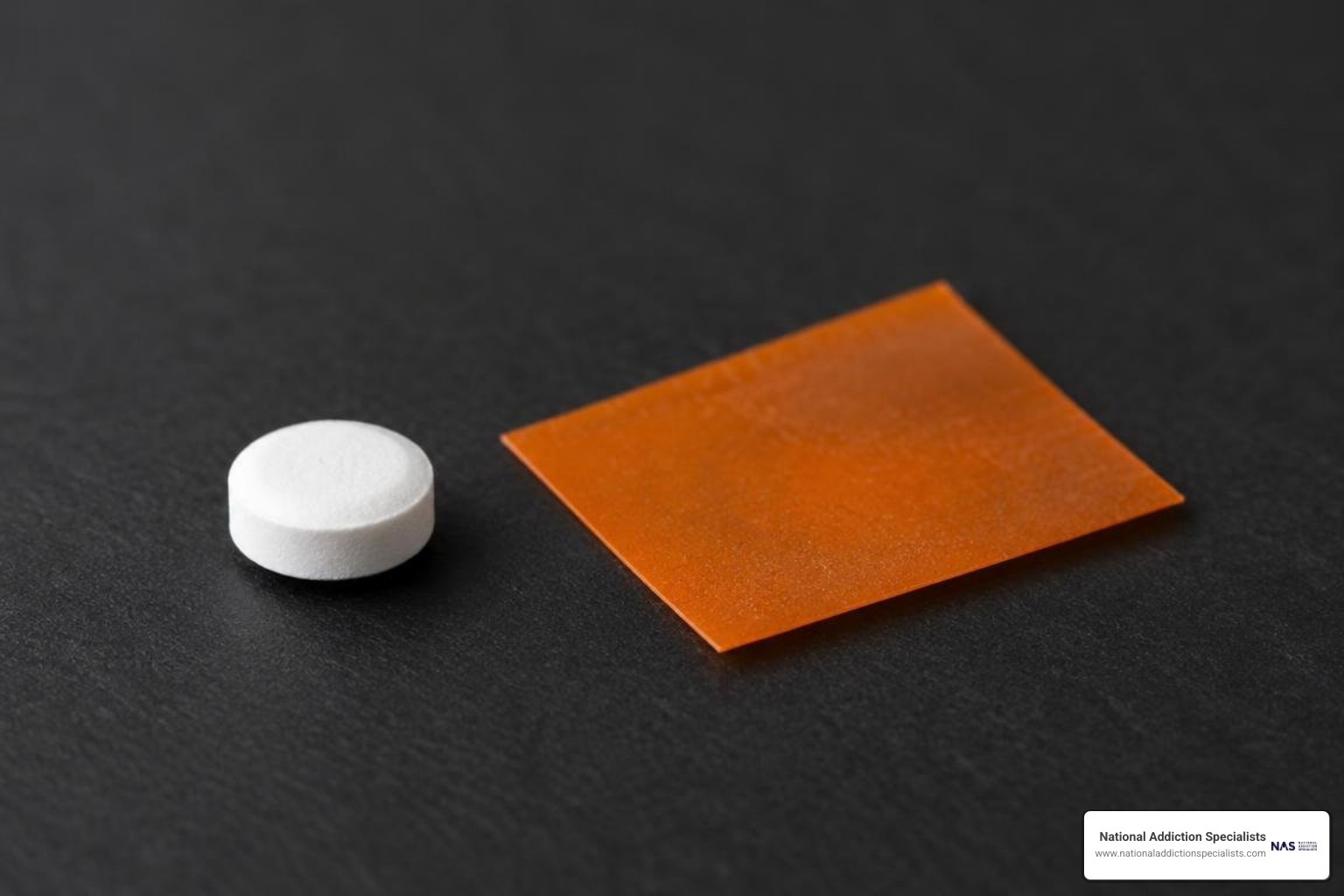
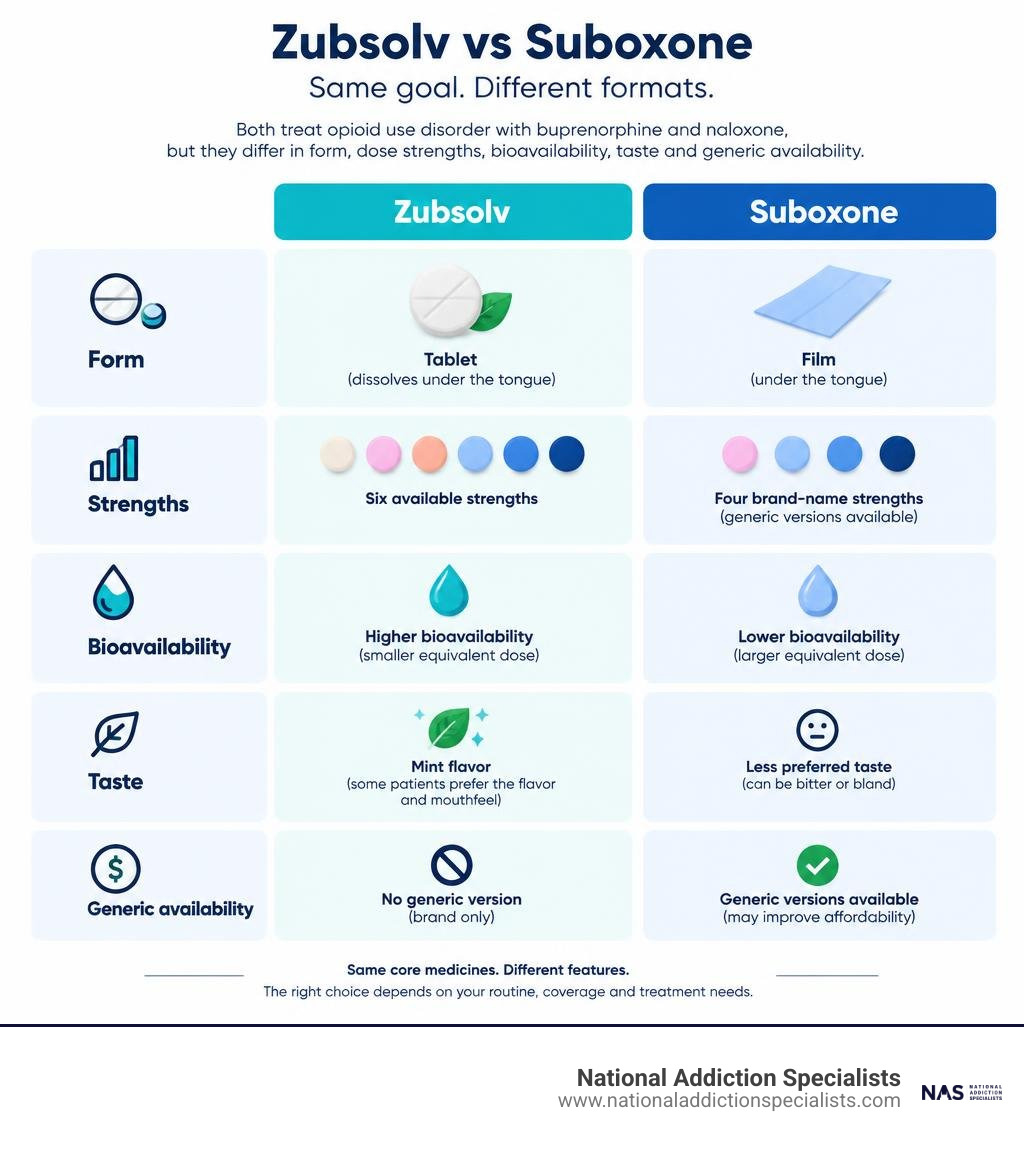
Zubsolv and Suboxone both treat opioid use disorder with buprenorphine and naloxone, but they differ in form, dose strengths, taste, and cost. Zubsolv is a mint-flavored tablet that dissolves under the tongue and is more bioavailable, so an equivalent dose is usually smaller. Suboxone is most often an under-the-tongue film and has generic options that may cost less.
For many people, the best choice comes down to what fits their routine and helps them take medication consistently:
- Zubsolv: Tablet form, six available strengths, faster dissolution, and a flavor and mouthfeel some patients prefer.
- Suboxone film: Four brand-name strengths, widely familiar film format, and generic versions that may improve affordability.
- Both: Use the same core medicines to reduce withdrawal symptoms and cravings when prescribed as part of opioid use disorder treatment.
Neither option is automatically better for everyone. The American Society of Addiction Medicine does not recommend one product over the other. Your clinician can help match the formulation, dose, insurance coverage, and daily routine to your treatment needs.
I am Chad Elkin, MD, a board-certified physician in Addiction Medicine and Internal Medicine and the Medical Director of National Addiction Specialists. In helping patients evaluate Zubsolv vs Suboxone, I focus on practical factors that support safe, consistent treatment and long-term recovery.
Zubsolv vs suboxone vocabulary:
Comparing Suboxone With Alternative Buprenorphine/Naloxone Formulations
When deciding between different recovery medications, understanding how buprenorphine works is an essential first step. Both Zubsolv and Suboxone are combination medications designed to treat opioid use disorder (OUD). They rely on the precise synergy between two active ingredients: buprenorphine and naloxone.
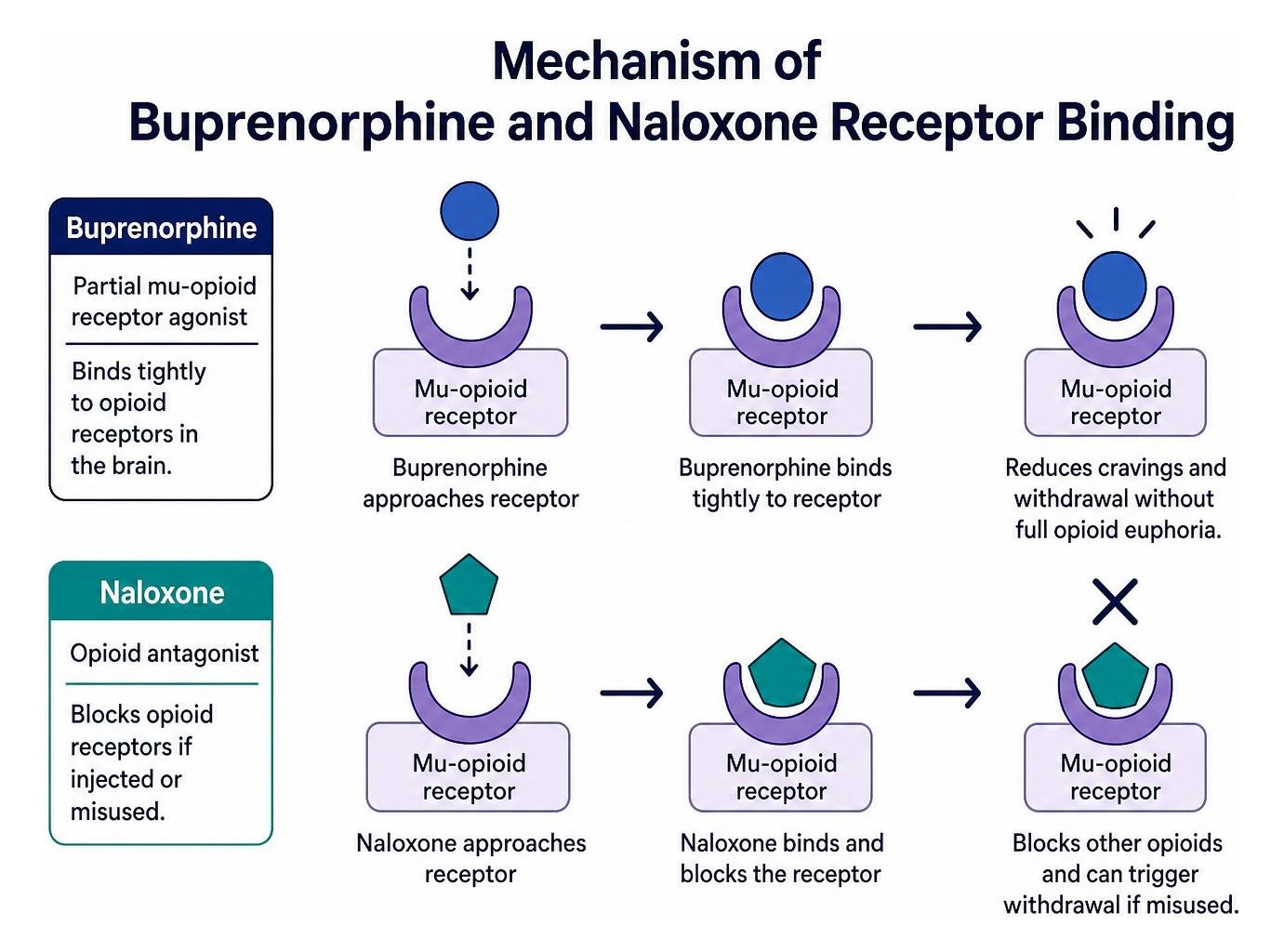
Buprenorphine acts as a partial mu-opioid receptor agonist. It binds tightly to the opioid receptors in the brain, satisfying cravings and preventing debilitating withdrawal symptoms without producing the intense euphoria associated with full opioids like oxycodone, heroin, or fentanyl. Naloxone, on the other hand, is an opioid antagonist. When taken sublingually as prescribed, naloxone has virtually no bioavailability and remains inactive. However, if someone attempts to crush, melt, or inject the medication, the naloxone activates immediately, blocking opioid receptors and triggering rapid withdrawal. This built-in abuse deterrent makes buprenorphine and naloxone combinations exceptionally safe for outpatient recovery.
To understand what is Suboxone, it helps to view it alongside other formulation alternatives. While both Zubsolv and Suboxone deliver the same life-saving active ingredients, the way they are manufactured alters how they enter your bloodstream, how they taste, and how your body absorbs them.
Formulation Types and Administration Methods
The delivery method of any sublingual medication determines how smoothly it fits into a patient’s morning routine. Suboxone is predominantly prescribed as a sublingual film—a small, flexible rectangular strip placed under the tongue or against the inside of the cheek (buccal administration). As saliva contacts the film, it adheres to the mucosal tissue and gradually dissolves.
In contrast, Zubsolv is manufactured as a small, fast-dissolving sublingual tablet. Using advanced micro-particle formulation technology, the tablet disintegrates quickly upon contact with oral mucosa. Many patients find that tablets feel more familiar than films, while others prefer the way films adhere in place without sliding around the mouth. Exploring Suboxone vs Subutex and other buprenorphine alternatives reveals that small differences in oral delivery can significantly influence daily comfort.
Dosage Strengths and Bioavailability
One of the most noticeable pharmacological differences between Zubsolv and Suboxone is bioavailability. Bioavailability refers to the percentage of an active drug that successfully enters systemic circulation to produce its therapeutic effect.
Zubsolv features higher bioavailability than Suboxone film. Because Zubsolv dissolves rapidly and delivers buprenorphine across the mucous membranes with greater efficiency, a patient requires a lower physical milligram dose of Zubsolv to achieve the exact same clinical blood concentration as a higher dose of Suboxone.
Reviewing standard Suboxone dosage information illustrates this contrast:
Suboxone Film Strengths (4 options):
- 2 mg buprenorphine / 0.5 mg naloxone
- 4 mg buprenorphine / 1 mg naloxone
- 8 mg buprenorphine / 2 mg naloxone
- 12 mg buprenorphine / 3 mg naloxone
Zubsolv Tablet Strengths (6 options):
- 0.7 mg buprenorphine / 0.18 mg naloxone
- 1.4 mg buprenorphine / 0.36 mg naloxone
- 2.9 mg buprenorphine / 0.71 mg naloxone
- 5.7 mg buprenorphine / 1.4 mg naloxone (equivalent to an 8 mg / 2 mg Suboxone film)
- 8.6 mg buprenorphine / 2.1 mg naloxone (equivalent to an 11.4 mg / 2.9 mg Suboxone dose)
- 11.4 mg buprenorphine / 2.9 mg naloxone (equivalent to a 16 mg / 4 mg Suboxone dose)
| Feature | Zubsolv | Suboxone Film |
|---|---|---|
| Primary Form | Sublingual Tablet | Sublingual / Buccal Film |
| Available Strengths | 6 distinct dosage strengths | 4 distinct dosage strengths |
| Bioavailability | Higher (~30% greater absorption) | Standard sublingual baseline |
| Equivalent to 8/2 mg | 5.7 mg / 1.4 mg | 8 mg / 2 mg |
| Primary Flavor Profile | Menthol / Mint | Citrus / Lime-Orange |
| Generic Availability | Brand name only | Multiple generic options available |
Because Zubsolv provides six distinct strengths compared to Suboxone’s four, clinicians have finer control when adjusting doses, whether stabilizing early recovery or planning a gentle taper.
Make an Appointment to Treat Addiction Please don’t hesitate. Make an appointment today.
Why Patients May Prefer an Alternative to Suboxone Film
Long-term recovery is built on small daily habits. When a medication is easy and pleasant to take, patients are far more likely to stick with their treatment plan without missing doses.
Taste, Texture, and Dissolution Speed
The sensory experience of taking sublingual medicine every morning matters. Suboxone film is known for its distinct citrus-lime flavor, which many patients describe as somewhat bitter or medicinal, leaving an unpleasant aftertaste that lingers. Additionally, some individuals dislike the feeling of a film adhering to the floor of the mouth or reporting a mild tingly sensation during absorption.
Zubsolv was engineered with patient comfort in mind. It has a clean, menthol-mint flavor designed to mask the natural bitterness of buprenorphine. Furthermore, because Zubsolv tablets dissolve considerably faster than sublingual films, patients spend less time holding saliva under their tongues and waiting before they can speak, drink water, or eat breakfast. In clinical studies on patient preference, patients have reported preferring Zubsolv to Suboxone film primarily due to its taste, texture, and quick oral dissolution.
Treatment Adherence and Individualized Care
When people find their daily dose unpalatable or inconvenient, adherence can slip. In comprehensive medication-assisted treatment (MAT), personalized care is crucial. If a patient experiences taste fatigue, nausea, or mouth sensitivity with films, switching to a minty sublingual tablet like Zubsolv can restore comfort and treatment compliance.
Furthermore, comparative clinical research highlights that both medications achieve comparable clinical outcomes in suppressing withdrawal and curbing illicit opioid use. When efficacy is equal, patient preference becomes a primary driver in selecting the best option.
Clinical Guidelines, Side Effects, and Cost Considerations

Both medications are proven tools for stabilizing brain chemistry and supporting recovery. Choosing between them involves balancing physical tolerability, clinical guidance, and financial practicalities.
Side Effect Profiles and Tolerability
Because Zubsolv and Suboxone deliver the same core active ingredients, their side effect profiles are remarkably similar. Most side effects are mild to moderate and tend to diminish as your body adjusts:
- Headache
- Mild nausea or stomach upset
- Constipation
- Oral numbness, tingling, or redness at the placement site
- Insomnia or sleep disturbances
- Mild sweating or dizziness
If a patient experiences severe oral irritation from the film matrix or is sensitive to the flavorings in Suboxone, transitioning to Zubsolv often resolves the localized discomfort.
Clinical Recommendations and Generic Availability
The American Society of Addiction Medicine (ASAM) does not recommend one buprenorphine/naloxone formulation over another. ASAM clinical practice guidelines emphasize individualized treatment, advising clinicians to select the formulation that best supports the patient’s lifestyle, clinical history, and financial situation. Clinical studies evaluating Zubsolv and Suboxone confirm that both formulations provide clinical equivalence regarding treatment retention and safety.
Cost, however, is a notable point of divergence. Generic versions of Suboxone film and tablets are widely available, making Suboxone an affordable choice for many patients paying out of pocket or utilizing state health programs. There are currently no generic forms of Zubsolv on the market, meaning brand-name Zubsolv may carry higher co-pays depending on your commercial insurance plan. At National Addiction Specialists, we work closely with patients across Tennessee and Virginia to navigate insurance coverage, Medicaid, and Medicare to ensure recovery medications remain accessible.
Frequently Asked Questions About Suboxone and Alternative Buprenorphine/Naloxone Formulations
How long does Suboxone stay in your system?
Buprenorphine has a long elimination half-life, ranging from roughly 24 to 42 hours. Because the drug is metabolized slowly by the liver into active metabolites like norbuprenorphine, it remains detectable in urine drug screens for several days up to a couple of weeks following the last dose, depending on an individual’s metabolic rate, hydration, and dosage history.
How long does Suboxone block other opioids?
Suboxone provides a robust opioid blockade effect for approximately 24 to 72 hours after administration. Buprenorphine binds to mu-opioid receptors with exceptionally high affinity, outcompeting full agonist opioids like morphine, heroin, or hydrocodone. This blockade prevents other opioids from producing euphoria and offers a protective barrier against accidental overdose during recovery.
Do clinical guidelines recommend one drug over the other?
No. Leading medical bodies, including ASAM, consider Zubsolv and Suboxone clinically comparable in efficacy. The choice between them relies on provider discretion, patient preference regarding taste and dissolution, formulation tolerance, and prescription insurance formularies.
Conclusion: Choosing the Right Treatment for Recovery
Finding the right recovery medication is a personal journey. Whether you prefer the fast-dissolving, mint-flavored Zubsolv tablet or the widely accessible Suboxone sublingual film, both medications provide the foundation needed to reclaim your health and future.
At National Addiction Specialists, our mission is to make evidence-based recovery seamless, supportive, and completely confidential. Through our modern telemedicine platform serving patients across Tennessee and Virginia—including our offices in Brentwood, TN, and Virginia Beach, VA—you can meet with board-certified addiction specialists from the comfort and privacy of your home. We accept Medicaid, Medicare, and major insurance plans to make care accessible for everyone.
Take the first step toward lasting wellness today by completing your new patient registration and connecting with our dedicated medical team.
Suboxone® and Subutex® are a registered trademark of Indivior UK Limited. Any mention and reference of Suboxone® and Subutex® in this website is for informational purposes only and is not an endorsement or sponsorship by Indivior UK Limited.
This article was medically reviewed by: Chad Elkin, MD, DFASAM is a board-certified addiction medicine physician, founder, and Chief Medical Officer of National Addiction Specialists, dedicated to treating substance use disorders. A Distinguished Fellow of the American Society of Addiction Medicine (ASAM), Dr Elkin currently serves as President of the Tennessee Society of Addiction Medicine (TNSAM) and has held various leadership roles within the organization. Dr Elkin chairs ASAM’s Health Technology Subcommittee and is an active member of its Practice Management and Regulatory Affairs Committee, State Advocacy and Legislative Affairs Committee, and other committees. He also serves on the planning committee for the Vanderbilt Mid-South Addiction Conference. Committed to advancing evidence-based policy, Dr Elkin is Chairman of the Tennessee Association of Alcohol, Drug, & Other Addiction Services (TAADAS) Addiction Medicine Council, which collaborates with the TN Department of Mental Health & Substance Abuse Services (TDMHSAS). He has contributed to numerous local, state, and national task forces, helping develop professional guidelines, policies, and laws that align with best practices in addiction medicine. His work focuses on reducing addiction-related harm, combating stigma, and ensuring access to effective treatment.Passionate about the field of addiction medicine, he remains dedicated to shaping policy and enhancing patient care.