Suboxone Tapering 101: Saying Goodbye Without the Grumpiness
Why Learning How to Taper Off Suboxone Without Withdrawals Can Change Your Recovery
How to taper off Suboxone without withdrawals is possible — and it comes down to one core principle: go slow.
Here’s the short answer:
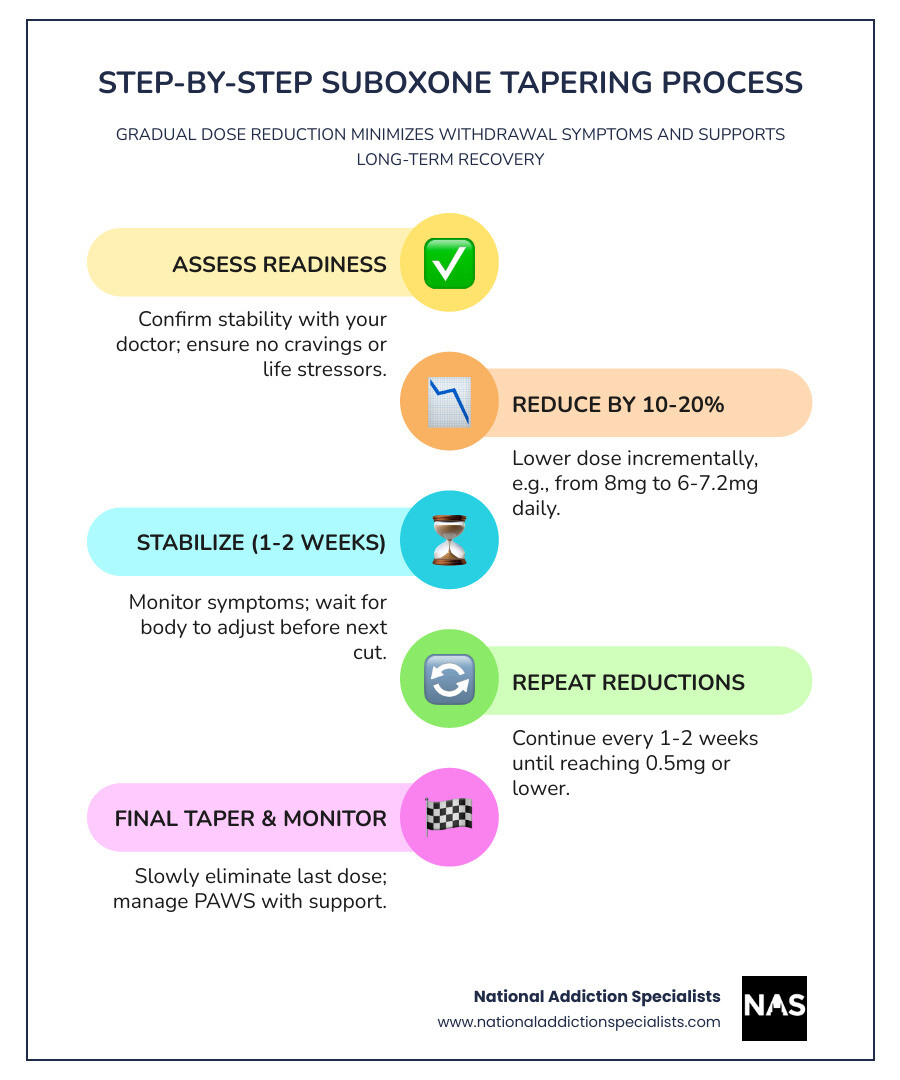
- Reduce your dose gradually — by 10–20% every 1–2 weeks
- Don’t skip steps — wait until symptoms settle before your next reduction
- Work with a doctor — a personalized plan is safer than going it alone
- Watch for PAWS — Post-Acute Withdrawal Syndrome can linger for months; slow tapering helps prevent it
- Support your body — hydration, sleep, exercise, and nutrition all matter
Suboxone has helped countless people break free from opioid dependence. But as your recovery progresses, it’s natural to wonder: “Can I eventually stop taking it — without feeling terrible?”
The honest answer is yes. But stopping too fast — or quitting cold turkey — puts you at real risk for withdrawal symptoms and relapse. Your body has adapted to buprenorphine’s presence. It needs time to readjust when that changes.
The good news? A carefully paced taper, done under medical supervision, can make this transition far more comfortable than most people expect.
I’m Chad Elkin, MD, board-certified in Addiction Medicine and founder of National Addiction Specialists. With over two decades of experience helping patients navigate how to taper off Suboxone without withdrawals, I’ve refined protocols that prioritize your comfort, safety, and long-term success. In this guide, I’ll walk you through exactly what works — and what to watch out for.
Quick how to taper off suboxone without withdrawals terms:
Understanding the Suboxone Withdrawal Timeline

When we talk about buprenorphine—the primary active ingredient in Suboxone—we are talking about a “long-acting” medication. Unlike short-acting opioids like heroin or oxycodone, which leave the system quickly and cause “crash” withdrawals, Suboxone lingers. This is due to its long half-life, which can range from 24 to 42 hours.
Because it stays in your system so long, suboxone-withdrawal doesn’t usually start the moment you miss a dose. It takes time for the levels in your blood to drop enough for your brain to notice. Understanding the from-start-to-finish-understanding-the-suboxone-withdrawal-timeline is essential for planning your exit strategy.
The Acute Phase
Typically, physical symptoms begin within 12 to 48 hours after your last dose. The peak of these symptoms—where you might feel the most “grumpy” or physically uncomfortable—usually occurs around day three. While heroin withdrawal might be over in a week, Suboxone withdrawal can stretch out for several weeks if not managed correctly.
| Feature | Heroin Withdrawal | Suboxone Withdrawal |
|---|---|---|
| Onset | 6–12 hours | 12–48 hours |
| Peak Intensity | Day 2–3 | Day 3–5 |
| Duration of Acute Symptoms | 5–10 days | 14–20 days |
| Risk of PAWS | High | Moderate (Lower with slow taper) |
By choosing to taper, we are essentially “tricking” the brain. We lower the dose so slightly that the receptors in the brain barely notice the change, allowing the body to maintain stability while slowly returning to its natural state.
How to Taper Off Suboxone Without Withdrawals Safely
The most important thing to remember is that tapering is not a race. We often see patients who are eager to be “done” with medication, but rushing the process is the number one cause of relapse. At National Addiction Specialists, we emphasize that how-to-taper-off-suboxone requires a partnership between you and your provider.
Medical supervision is vital because a doctor can help you distinguish between “true” withdrawal and the anxiety that often comes with dose reduction. We use a method called direct tapering, which involves staying on Suboxone but gradually lowering the amount you take until you reach a “jump-off” point—usually a tiny fraction of your original dose.
Before starting, we assess patient readiness. Are you stable in your job? Are your relationships healthy? Have you been relapse-free for a significant period? If the answer is yes, we begin the stabilization phase, ensuring you are comfortable on your current dose before making the first cut.
The Golden Rule: How to Taper Off Suboxone Without Withdrawals Using the 10% Method
If there is a “secret sauce” to a successful taper, it is the 10% rule. Research and clinical experience show that reducing your daily dose by 10% to 20% every one to two weeks is the “sweet spot” for most people.
Does does-suboxone-help-with-withdrawal-symptoms? Absolutely. By keeping a baseline level of medication in your system, you prevent the severe “sickness” associated with quitting. This incremental approach allows for physiological adjustment. If you are taking 8mg, your first reduction might be to 7mg or 6mg. You stay there for at least two weeks. If you feel fine, we go lower. If you feel shaky, we “hold” at that dose until you stabilize.
Managing PAWS: How to Taper Off Suboxone Without Withdrawals Long-Term
Even after the physical “flu-like” symptoms vanish, some people experience Post-Acute Withdrawal Syndrome (PAWS). This is the brain’s way of recalibrating its chemistry. Symptoms can include:
- Anxiety and irritability
- Depression or “flat” emotions (anhedonia)
- Sleep disturbances
- Brain fog
The goal of suboxone-withdrawal-treatment is to minimize these long-term effects. A slow taper is actually the best defense against PAWS. By giving your brain months—or even years—to adjust, you allow for neuroadaptation. This means your brain starts producing its own “feel-good” chemicals again, leading to better mood regulation once the medication is completely gone.
Strategies for a Comfortable Transition
While the medication schedule is the skeleton of your taper, your lifestyle is the muscle that keeps you moving forward. We recommend a “whole-body” approach to manage what-to-expect-suboxone-side-effects during the process.
1. Hydration and Nutrition: Opioid withdrawal often causes GI upset. Drinking plenty of water and eating a balanced diet can help your body repair itself. We’ve found that specific supplements can be game-changers:
- Magnesium: Helps with restless legs and muscle aches.
- Vitamin D: Supports mood and immune function, which are often depleted during recovery.
2. Physical Activity: You don’t need to run a marathon, but a 20-minute walk can release natural endorphins. This is nature’s way of helping you feel better without a pill.
3. Adjunct Medications: Sometimes, even a slow taper needs a little extra help. We may prescribe non-opioid “comfort meds” to bridge the gap:
- Clonidine: An older blood pressure medication that is excellent at stopping the “chills,” sweating, and anxiety of withdrawal.
- Gabapentin: Can help with nerve pain and sleep disturbances (used carefully under supervision).
- Hydroxyzine: A non-addictive antihistamine that helps with anxiety and insomnia.
Make an Appointment to Treat Addiction
Please don’t hesitate. Make an appointment today. https://www.nationaladdictionspecialists.com/new-patient-packet/
When to Slow Down or Seek Help
One of the biggest myths in recovery is that you have to suffer to prove you’re getting better. That simply isn’t true. If you are wondering how-long-should-i-stay-on-suboxone, the answer is: as long as it takes to keep you safe and functional.
There are “pause points” in every taper. For many, these happen at the 4mg, 2mg, and 1mg marks. These are the doses where buprenorphine’s effect on the brain’s receptors changes most drastically. If you experience a major life stressor—like a job loss or a family emergency—it is perfectly okay to stop reducing your dose and just “maintain” for a while.
So, how-long-does-suboxone-treatment-last? For some, it’s a few months; for others, it’s years. Our role is to provide professional monitoring and behavioral therapy to help you navigate the mental hurdles. If you find yourself thinking about using other drugs or if your anxiety becomes overwhelming, that is a sign to slow down and talk to your provider.
Frequently Asked Questions about Suboxone Tapering
Is a 7-day taper better than a 28-day taper?
Research shows that a 7-day taper can actually result in a higher rate of opioid-free urine tests immediately at the end of the taper (about 44% compared to 30% for a longer 28-day taper). However, short tapers often come with more intense withdrawal symptoms. For long-term clinical stabilization and comfort, most patients find that a much longer, multi-month taper is more sustainable and prevents the “rebound” effect that leads to relapse.
Can I use Kratom to help with the taper?
We strongly advise against this. While Kratom is marketed as a “natural” supplement, it acts on the same opioid receptors in the brain. Using Kratom to get off Suboxone is often just trading one dependence for another, and Kratom carries its own risks of addiction and unregulated contaminants. We prefer using FDA-approved comfort medications that we can monitor safely.
What are the best alternatives after finishing a taper?
Once you have successfully reached zero, you might want an “insurance policy” against relapse.
- Vivitrol: A monthly injection of naltrexone (an opioid blocker). It is not an opioid and has no withdrawal symptoms, but it prevents you from getting high if you slip up.
- Sublocade: Some patients find that switching to this monthly buprenorphine injection before their final taper makes the process even smoother, as it leaves the body very slowly over several months.
Conclusion
At National Addiction Specialists, we believe that your journey off Suboxone should be as empowering as your journey onto it. Whether you are in Brentwood, TN, Virginia Beach, VA, or anywhere across Tennessee and Virginia, our telemedicine-based care ensures you don’t have to face this alone.
We provide personalized recovery plans from the comfort of your home, accepting Medicaid and Medicare to make sure expert care is accessible. Tapering off Suboxone is a significant milestone—it’s the final step toward complete independence. By following a medically guided, slow-reduction plan, you can say goodbye to the medication without the “grumpiness” or the pain of withdrawal.
If you’re ready to take that next step, we are here to walk with you. For more detailed guides, visit our how-to-taper-off-suboxone resource page.
This article was medically reviewed by: Chad Elkin, MD, DFASAM is a board-certified addiction medicine physician, founder, and Chief Medical Officer of National Addiction Specialists, dedicated to treating substance use disorders. A Distinguished Fellow of the American Society of Addiction Medicine (ASAM), Dr Elkin currently serves as President of the Tennessee Society of Addiction Medicine (TNSAM) and has held various leadership roles within the organization. Dr Elkin chairs ASAM’s Health Technology Subcommittee and is an active member of its Practice Management and Regulatory Affairs Committee, State Advocacy and Legislative Affairs Committee, and other committees. He also serves on the planning committee for the Vanderbilt Mid-South Addiction Conference. Committed to advancing evidence-based policy, Dr Elkin is Chairman of the Tennessee Association of Alcohol, Drug, & Other Addiction Services (TAADAS) Addiction Medicine Council, which collaborates with the TN Department of Mental Health & Substance Abuse Services (TDMHSAS). He has contributed to numerous local, state, and national task forces, helping develop professional guidelines, policies, and laws that align with best practices in addiction medicine. His work focuses on reducing addiction-related harm, combating stigma, and ensuring access to effective treatment.Passionate about the field of addiction medicine, he remains dedicated to shaping policy and enhancing patient care.
Suboxone® and Subutex® are a registered trademark of Indivior UK Limited. Any mention and reference of Suboxone® and Subutex® in this website is for informational purposes only and is not an endorsement or sponsorship by Indivior UK Limited.