Is Sublocade Better Than Suboxone for Long-Term Recovery
Understanding the Core Differences in Sublocade vs Suboxone
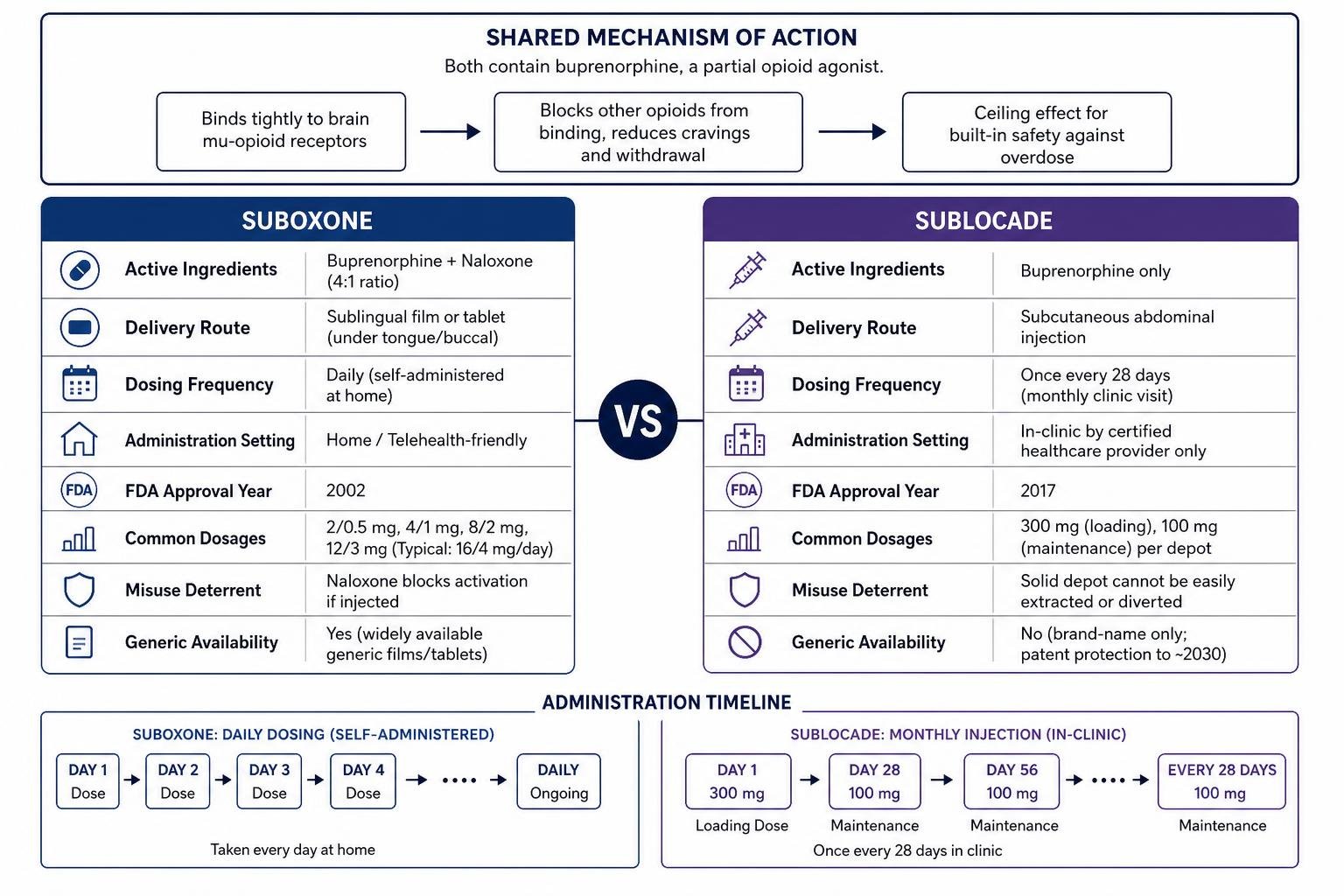
When comparing Sublocade vs Suboxone, neither medication is universally better for long-term recovery; rather, the best choice depends on individual patient needs and lifestyle. Sublocade provides monthly extended-release injections that simplify adherence and eliminate daily routines, while Suboxone offers flexible, affordable, and accessible daily at-home dosing ideal for rapid titration and telemedicine care. Both treatments share the same primary active ingredient: buprenorphine, a partial opioid agonist that satisfies cravings and prevents withdrawal while offering a ceiling effect against overdose. To better understand the biological mechanics, how buprenorphine works in the brain involves occupying receptor sites so thoroughly that other opioids cannot latch on.
Where the two medications diverge is their formulation, delivery mechanism, dosing schedule, and the inclusion of secondary ingredients.
| Feature | Suboxone | Sublocade |
|---|---|---|
| Active Ingredients | Buprenorphine + Naloxone (4:1 ratio) | Buprenorphine only |
| Delivery Route | Sublingual film or tablet (under tongue/buccal) | Subcutaneous abdominal injection |
| Dosing Frequency | Daily (self-administered at home) | Once every 28 days (monthly clinic visit) |
| FDA Approval Year | 2002 | 2017 |
| Common Dosages | 2/0.5 mg, 4/1 mg, 8/2 mg, 12/3 mg (Typical: 16/4 mg/day) | 300 mg (loading), 100 mg (maintenance) per depot |
| Administration Setting | Home / Telehealth-friendly | In-clinic by certified healthcare provider only |
| Generic Availability | Yes (widely available generic films/tablets) | No (brand-name only; patent protection to ~2030) |
| Misuse Deterrent | Naloxone blocks activation if injected | Solid depot cannot be easily extracted or diverted |
How Suboxone Film Works: Daily Dosing and Induction
Suboxone combines buprenorphine with naloxone, an opioid antagonist, in a 4:1 ratio. The naloxone component serves purely as an abuse deterrent. When taken properly under the tongue (sublingually) or inside the cheek (buccally), the body absorbs very little naloxone into the bloodstream. However, if someone attempts to crush, dissolve, and inject the film, the naloxone activates immediately, triggering rapid, uncomfortable precipitated withdrawal.
Suboxone is ideal for induction—the initial phase of transitioning off illicit opioids. A provider can tailor early dosing precisely, starting with up to 8 mg buprenorphine / 2 mg naloxone on day one, and titrating up to 16 mg / 4 mg by day two. This flexibility allows our team to fine-tune your dose to match your individual metabolic rate and symptom level from the comfort of home.
How Sublocade Injection Works: Monthly Extended-Release Depot
Sublocade takes a completely different route. It contains no naloxone because the formulation itself prevents misuse. Administered exclusively as a subcutaneous injection into the abdominal tissue by a qualified healthcare professional, the liquid medication mixes with bodily fluids to form a solid, biodegradable deposit under the skin—often described as feeling like a smooth, pea-sized mass.
This depot quietly releases a steady stream of buprenorphine over approximately 28 days. The standard treatment schedule begins with two monthly 300 mg loading doses to rapidly establish high, stable blood concentrations, followed by a monthly 100 mg maintenance dose starting in the third month (though some patients remain on 300 mg if clinically indicated). Because a clinician injects it directly, there are no daily strips to keep track of or take.
Buprenorphine Monotherapy Comparison: Naloxone, Pregnancy, and Sensitivity Considerations
Before Suboxone dominated the sublingual landscape, pure buprenorphine sublingual tablets were sold under the brand name Subutex. While brand-name Subutex was discontinued, generic buprenorphine monotherapy tablets remain available today.
Understanding the clinical difference between pure buprenorphine and combination therapy is essential when choosing your path: methadone, Suboxone, or Subutex for opioid recovery. Suboxone is the standard choice for most individuals because naloxone deters intravenous diversion. However, buprenorphine monotherapy is clinically indicated for patients with true naloxone allergies or sensitivities (which can cause severe headaches or gastrointestinal distress). Additionally, while modern medical research shows combination products can be safe, many prenatal protocols still prefer monotherapy during pregnancy to minimize fetal exposure to multiple compounds. Sublocade also provides pure buprenorphine monotherapy, but its monthly depot format requires distinct clinical evaluation before use during pregnancy.
Treatment Effectiveness and Adherence: Injection vs Film Delivery
Clinical research consistently shows that buprenorphine-based medication-assisted treatment (MAT) reduces illicit opioid use by 50% or more while dramatically reducing overdose mortality. Yet, a medication can only work if it gets into your system. When comparing the clinical success of medication-assisted treatment options, the debate between injection and film delivery centers largely on treatment adherence and lifestyle alignment.
Both delivery methods achieve high rates of treatment retention when paired with comprehensive behavioral healthcare. Research from clinical trials emphasizes that matching the delivery system to a patient’s personal routine is the strongest predictor of long-term stability.
Clinical Outcomes and Retention in Sublocade vs Suboxone Treatment
Suboxone films produce slight daily peaks and troughs in buprenorphine blood levels. For the vast majority of patients, taking a daily film keeps cravings and withdrawal suppressed around the clock. However, life happens: busy work schedules, forgetfulness, chaotic living environments, or travel can lead to missed doses. A missed dose can cause mild withdrawal or psychological anxiety, occasionally opening the door to cravings.
Sublocade removes daily adherence from the equation entirely. By maintaining continuous, stable plasma concentrations of buprenorphine for an entire month, it eliminates daily fluctuations. Patients who struggle with the routine of daily medication often find this continuous coverage liberating. It also eliminates the temptation to skip a dose or divert medication.
Conversely, Suboxone empowers patients with active daily engagement in their recovery routine. Daily dosing can serve as a mindful morning grounding habit, reinforcing one’s commitment to health while maintaining simple, at-home access.
Withdrawal and Discontinuation: Managing the Tapering Process
Eventually, many individuals explore tapering off their medication. The discontinuation experience differs markedly between films and injections:
- Suboxone Discontinuation: Stopping Suboxone requires a structured, gradual step-down protocol managed over weeks or months. Providers slowly reduce the daily film strength (e.g., from 16 mg down to 8 mg, 4 mg, 2 mg, and lower). Because the body clears daily sublingual buprenorphine within days, stepping down too quickly can trigger physical withdrawal symptoms.
- Sublocade Discontinuation: Sublocade provides what many clinicians describe as a “built-in taper.” Because the solid subcutaneous depot dissolves extremely slowly, buprenorphine remains detectable in the body for several months after the final injection. Plasma levels decline so gradually that many patients experience minimal to no acute withdrawal symptoms compared to rapid sublingual discontinuation.
Regardless of formulation, stopping treatment should always be done in close collaboration with an addiction medicine specialist to guard against relapse.
Side Effects, Safety Profiles, and Administration Risks
Both Suboxone and Sublocade are well-tolerated medications with proven safety records. Because both deliver buprenorphine, they share many systemic side effects. However, their unique delivery routes introduce distinct safety considerations.
For broader guidance on managing these symptoms, our Suboxone treatment options complete guide provides actionable strategies for maintaining comfort throughout recovery.
Common and Serious Side Effects in Sublocade vs Suboxone Therapy
- Suboxone-Specific Effects: Because films dissolve orally, some patients experience oral numbness, mouth redness, or mild tongue irritation. In recent years, the FDA has highlighted potential dental issues (such as tooth decay or enamel erosion) with long-term sublingual buprenorphine use. Patients can protect their dental health by thoroughly rinsing their mouth with water after the film dissolves and waiting at least one hour before brushing their teeth.
- Sublocade-Specific Effects: The most frequent side effects unique to Sublocade occur at the injection site. Patients may notice temporary pain, redness, swelling, bruising, or itching where the depot was placed. These local reactions are usually mild and resolve within a few days.
- Shared Serious Risks: While rare due to the buprenorphine ceiling effect, combining either medication with central nervous system depressants—such as benzodiazepines, sedatives, or heavy alcohol—significantly increases the risk of dangerous respiratory depression and profound sedation. Periodic liver function monitoring is also recommended for patients with preexisting hepatic impairment.
REMS Program, Boxed Warning, and In-Clinic vs Telehealth Safety
Sublocade carries an FDA Boxed Warning regarding the serious risk of intravenous injection. If Sublocade were inadvertently injected into a vein instead of abdominal subcutaneous fat, the liquid would form a solid mass inside the bloodstream, potentially causing life-threatening blood clots, pulmonary embolism, tissue damage, or death.
To prevent this, the FDA mandates a strict Risk Evaluation and Mitigation Strategy (REMS) program. Under this program:
- Sublocade is never dispensed directly to patients at a retail pharmacy.
- The medication must be ordered through a certified specialty pharmacy and shipped directly to a healthcare setting.
- Only REMS-certified healthcare professionals may administer the injection.
Suboxone does not carry this specific physical depot risk, making it exceptionally safe for outpatient home use and perfectly suited for modern telemedicine care. Through compliant virtual visits, patients can receive high-quality addiction care without traveling to a clinic every week.
Make an Appointment to Treat Addiction Please don’t hesitate. Make an appointment today.
Transitioning, Cost Comparison, and Insurance Coverage
Cost and logistical accessibility are often the deciding factors for patients evaluating their options. A deeper look at effective opioid addiction medications illustrates how financial coverage shapes recovery decisions.

How to Switch From Suboxone to Sublocade Safely
Transitioning from daily sublingual films to monthly injections is common, safe, and medically straightforward. According to established clinical protocols, patients cannot start Sublocade immediately on day one of recovery.
Instead, patients must first undergo induction and stabilize on a transmucosal buprenorphine dose (such as Suboxone) equivalent to 8 mg to 24 mg daily for at least 7 days. This prerequisite ensures that your body tolerates buprenorphine well and allows your physician to confirm that you will not experience adverse allergic or physiological reactions.
Once stabilized, patients receiving 8–24 mg daily can transition directly to their first 300 mg Sublocade injection on the same day their sublingual dose is discontinued. If a patient ever needs to switch back from Sublocade to daily Suboxone, providers carefully monitor the slow dissolution of the depot before gradually reintroducing sublingual films.
Out-of-Pocket Pricing, Generic Availability, and Insurance Support
The financial landscape differs dramatically between the two treatments:
- Generic Suboxone: Since generic buprenorphine/naloxone sublingual films and tablets became widely available in 2018, prices have dropped by 60% to 80%. Without insurance, generic films generally cost between $100 and $300 per month, while generic tablets can cost as little as $50 to $200 per month. Suboxone is widely covered on the preferred drug lists of nearly all commercial insurance plans, Medicare, and state Medicaid programs across Tennessee and Virginia.
- Sublocade: Because Sublocade is protected by patents expected to last until at least 2030, no generic version exists. The list price for a single monthly Sublocade injection ranges from $1,500 to $1,900. While many commercial plans and Medicaid programs cover Sublocade, it frequently requires extensive prior authorization paperwork, and copayments can be substantial without manufacturer copay assistance programs (such as the INSUPPORT copay savings program).
To explore transparent pricing and coverage options, please review our comprehensive guide on insurance and pricing.
Choosing the Right Path: Who Is the Ideal Candidate for Each Option?
No two recovery journeys look the same. Understanding what Suboxone is and how it contrasts with long-acting injections allows you to match your treatment with your life. Additional clinical perspectives on buprenorphine formulations are available through the National Institute on Drug Abuse.

When Suboxone Daily Dosing Is the Best Fit
Suboxone is often the ideal choice for individuals who value flexibility, home privacy, and cost-effective care:
- Early Induction: Patients starting their recovery journey who need quick dose adjustments to control early cravings.
- Telemedicine Seekers: Individuals in Tennessee or Virginia looking for confidential, top-tier addiction medicine care from home without commuting to a clinic.
- Budget-Conscious Individuals: Those relying on affordable generic prescriptions with low pharmacy copays.
- Structured Routines: Patients who feel confident managing a daily medication routine and appreciate keeping recovery progress directly in their hands.
When Monthly Sublocade Injections Offer an Advantage
Sublocade can be a game-changer for individuals facing specific adherence challenges:
- Daily Adherence Fatigue: People who struggle to remember daily doses, work irregular shifts, or find daily administration mentally stressful.
- Trigger Reduction: Individuals for whom the daily ritual of dissolving a film feels uncomfortably reminiscent of past substance use rituals.
- Privacy & Travel: Patients who travel frequently or live in shared housing where storing controlled substances poses security or privacy risks.
- Diversion Concerns: Situations where removing take-home medication eliminates external pressures from peers or family members.
For a focused comparison between short-acting buprenorphine tablets and film formulations, read our breakdown of Suboxone vs Subutex.
Frequently Asked Questions About Sublocade and Suboxone
Can you switch back to Suboxone after starting Sublocade?
Yes. If you decide that monthly injections do not fit your lifestyle, your doctor can transition you back to daily sublingual Suboxone. Because the Sublocade depot releases buprenorphine over several months, you will not need to restart Suboxone immediately the day after your next scheduled injection would have been. Instead, your clinician will monitor your symptoms as the depot slowly clears, introducing low-dose sublingual films when your plasma levels dip and cravings or mild withdrawal symptoms emerge.
Does Sublocade completely eliminate opioid withdrawal symptoms?
For most patients, yes. Sublocade provides smooth, continuous plasma levels of buprenorphine, eliminating the subtle daily peaks and troughs of oral dosing. However, during the first week after your very first injection, you might experience mild transition symptoms as the depot establishes steady-state concentrations. Your doctor may provide a few supplemental low-dose sublingual films during this brief adjustment window if needed.
Is Sublocade covered by Medicaid and Medicare?
Yes, many state Medicaid formularies (including plans in Tennessee and Virginia) and Medicare Part B/Part D plans cover Sublocade. However, coverage often requires specific clinical criteria, prior authorizations, and ordering through specialty pharmacies. In contrast, generic Suboxone sublingual films are standard preferred items on almost all formularies, allowing rapid same-day pharmacy pickup.
Conclusion: Making the Right Choice for Your Long-Term Recovery
When deciding between Sublocade and Suboxone, both medications are gold-standard, evidence-based tools for overcoming opioid use disorder. Suboxone offers unmatched dosing flexibility, broad affordability, generic availability, and the convenience of telemedicine-based home care. Sublocade provides steady, month-long freedom from daily medication routines and simplifies adherence.
The most effective medication is the one that aligns with your daily life, your budget, and your personal recovery goals. At National Addiction Specialists, we provide compassionate, confidential, and comprehensive telemedicine-based Suboxone treatment across Tennessee and Virginia, accepting Medicaid, Medicare, and commercial insurance.
To take your next step toward lasting recovery with our experienced medical team, visit our homepage or download your new patient packet to schedule your private virtual consultation today.
Suboxone® and Subutex® are a registered trademark of Indivior UK Limited. Any mention and reference of Suboxone® and Subutex® in this website is for informational purposes only and is not an endorsement or sponsorship by Indivior UK Limited.
This article was medically reviewed by: Chad Elkin, MD, DFASAM is a board-certified addiction medicine physician, founder, and Chief Medical Officer of National Addiction Specialists, dedicated to treating substance use disorders. A Distinguished Fellow of the American Society of Addiction Medicine (ASAM), Dr Elkin currently serves as President of the Tennessee Society of Addiction Medicine (TNSAM) and has held various leadership roles within the organization. Dr Elkin chairs ASAM’s Health Technology Subcommittee and is an active member of its Practice Management and Regulatory Affairs Committee, State Advocacy and Legislative Affairs Committee, and other committees. He also serves on the planning committee for the Vanderbilt Mid-South Addiction Conference. Committed to advancing evidence-based policy, Dr Elkin is Chairman of the Tennessee Association of Alcohol, Drug, & Other Addiction Services (TAADAS) Addiction Medicine Council, which collaborates with the TN Department of Mental Health & Substance Abuse Services (TDMHSAS). He has contributed to numerous local, state, and national task forces, helping develop professional guidelines, policies, and laws that align with best practices in addiction medicine. His work focuses on reducing addiction-related harm, combating stigma, and ensuring access to effective treatment.Passionate about the field of addiction medicine, he remains dedicated to shaping policy and enhancing patient care.