Finding the Right Addiction Specialist in Your Neighborhood
Why Finding a Drug and Alcohol Counselor Near Me Can Change Everything
If you’re looking for a drug and alcohol counselor near me, here’s how to find qualified help fast:
| Step | What to Do |
|---|---|
| 1 | Search directories like Psychology Today or National Addiction Specialists |
| 2 | Filter by location, insurance, and specialty (e.g., opioids, co-occurring disorders) |
| 3 | Verify the counselor’s license through your state licensing board |
| 4 | Book a free 15-minute consultation before committing |
| 5 | Ask about telehealth if in-person visits are hard to manage |
Addiction is more common than most people realize — and more treatable than many expect.
Research shows that more than three-quarters of people who develop an alcohol or drug addiction go on to recover with effective treatment. Five years after stopping substance use, a person’s risk of relapse is no higher than someone who was never addicted at all.
That’s not a small thing. That’s real hope, backed by data.
But recovery rarely happens in isolation. The right professional support — a licensed, experienced addiction counselor — makes a measurable difference in outcomes. Whether you’re dealing with opioid dependence, alcohol use disorder, or a combination of substance use and mental health challenges, there is a path forward.
This list will help you find it.
I’m Dr. Chad Elkin, board-certified in Addiction Medicine and founder and Medical Director of National Addiction Specialists — a national telehealth company built specifically to connect people searching for a drug and alcohol counselor near me with qualified addiction specialists who remove the barriers to care. As a Fellow of the American Society of Addiction Medicine and Legislative Chairman of the Tennessee Society of Addiction Medicine, I’ve dedicated my career to expanding access to evidence-based addiction treatment across Tennessee, Virginia, and beyond.
Essential Qualifications for an Addiction Specialist
When you begin your search for a drug and alcohol counselor near me, the alphabet soup of credentials can be overwhelming. Understanding what these letters mean ensures you are receiving care from someone who has met rigorous state standards for education and clinical experience.
The Credential Hierarchy
In the field of addiction, counselors move through a structured hierarchy of licensing. Depending on the state, you might see titles such as:
- ADT (Alcohol and Drug Trainee): An entry-level professional working under strict supervision while earning clinical hours.
- CSC-AD & CAC-AD: These are certified counselors who have completed specific associate or bachelor-level education in chemical dependency.
- LGADC & LCADC: These represent “Licensed Graduate” or “Licensed Clinical” Alcohol and Drug Counselors. An LCADC typically holds a master’s degree and can practice independently.
- CADC (Certified Alcohol and Drug Counselor): A widely recognized certification, such as the Certified Alcohol and Drug Counselor (CADC) in Tennessee, which requires specific work experience and passing a written examination.
- SUDP (Substance Use Disorder Professional): A common credential in states like Washington, indicating specialized training in addiction.
Beyond these specific addiction titles, many providers are “Licensed Clinicians,” such as Licensed Professional Counselors (LPC) or Licensed Clinical Social Workers (LCSW), who have chosen to specialize in substance use.
Experience matters just as much as the degree. For example, experts like Heather Robinson have over 20 years of experience, while Maryann Miranda has spent over 30 years in the addiction field. Others, like Emily Nelson, have specialized in both inpatient and outpatient settings since 2017, focusing on the intersection of substance use and mental health. At National Addiction Specialists, we believe this depth of addiction counseling services is the backbone of a successful recovery plan.
Verifying a Drug and Alcohol Counselor Near Me
You wouldn’t see a surgeon without checking their credentials, and addiction treatment should be no different. State regulatory boards exist for one primary reason: public protection. They ensure that every counselor meets a minimum proficiency standard and adheres to strict ethical guidelines.
If you are looking for a provider in Virginia, you can check the Virginia Board of Counseling – CSAC application info to understand the requirements for Certified Substance Abuse Counselors. Verification portals allow you to confirm that a license is active and see if there have been any disciplinary actions. Keeping up with “Continuing Education” is a requirement for these professionals, meaning your counselor is staying updated on the latest evidence-based recovery techniques.
How to Find a Drug and Alcohol Counselor Near Me
Finding a local provider used to mean flipping through a phone book. Today, it’s about using smart digital tools to find a “geographic match” that fits your life.

Targeted Geographic Search
Whether you are in the heart of Nashville, TN, or the coastal areas of Virginia Beach, VA, proximity matters. If you have to drive two hours for a session, you’re less likely to go when things get tough.
- Nashville & Brentwood, TN: This region has a robust network of specialists. You can find addiction therapists in Nashville, TN using online directories.
- Virginia Beach, VA: For those on the coast, looking for substance abuse counseling in Virginia Beach, VA or browsing addiction therapists in Virginia Beach can yield local experts.
Using Referral Networks
If you are struggling to find a “brick and mortar” office, or if local waitlists are months long, our team at Addiction Specialists Near Me provides a bridge. We specialize in serving Tennessee and Virginia through telemedicine, ensuring that “near me” means “right on your screen” without the travel time.
Make an Appointment to Treat Addiction Please don’t hesitate. Make an appointment today. https://www.nationaladdictionspecialists.com/new-patient-packet/
Evidence-Based Treatment Approaches and Services
Not all counseling is the same. Modern addiction treatment relies on “evidence-based” practices—methods that have been scientifically proven to work.
- Cognitive Behavioral Therapy (CBT): This helps you identify and change the thought patterns that lead to substance use.
- Dialectical Behavior Therapy (DBT): Excellent for emotional regulation and managing the “highs and lows” of early recovery.
- Motivational Interviewing (MI): A collaborative style that helps you find your own internal motivation to change.
- EMDR: Often used if trauma is a root cause of the addiction.
- Relapse Prevention: This involves creating a “battle plan” for high-risk situations.
The importance of counseling & therapy in Suboxone treatment cannot be overstated. While medication manages the physical cravings, counseling treats the behavioral and emotional aspects of the disease.
Therapy Comparison Table
| Type | Focus | Best For |
|---|---|---|
| Individual | One-on-one deep dives | Privacy and personalized goal setting |
| Group | Peer support and shared experience | Reducing isolation and learning from others |
| Family | Repairing relationships | Healing the “family system” and building support |
Specialized Services from a Drug and Alcohol Counselor Near Me
Many people aren’t just dealing with a substance; they are dealing with “co-occurring disorders” (also known as a dual diagnosis). This means having a mental health condition like depression or PTSD alongside an addiction.
Specialists also offer targeted counseling for opioid addiction, alcohol use disorder, and even process addictions like gambling. Whether you prefer a strict abstinence-based model or a harm-reduction approach, your counselor should tailor the treatment to your goals.
Navigating Costs, Insurance, and Virtual Care
The cost of treatment shouldn’t be the thing that keeps you from recovery. Most counselors offer a variety of financial options:
- Session Fees: These can range from $100 to $250+, but many offer a “sliding scale” based on income.
- Superbills: If a counselor is out-of-network, they can provide a superbill for you to submit to your insurance for partial reimbursement.
- Insurance: Many providers now accept major plans like Aetna, Cigna, and BlueCross. At National Addiction Specialists, we prioritize accessibility by accepting Medicaid and Medicare.
Telehealth vs. In-Person Care
The world has changed, and so has addiction treatment. Online addiction counseling has proven to be just as effective as sitting in a physical office.
Virtual care offers:
- Privacy: No sitting in a waiting room where you might run into a neighbor.
- Flexibility: Sessions can happen during a lunch break or from your living room.
- Statewide Access: Through telemedicine treatment, residents in rural parts of Tennessee or Virginia can access the same high-level experts found in big cities.
Frequently Asked Questions
What should I expect during the first session?
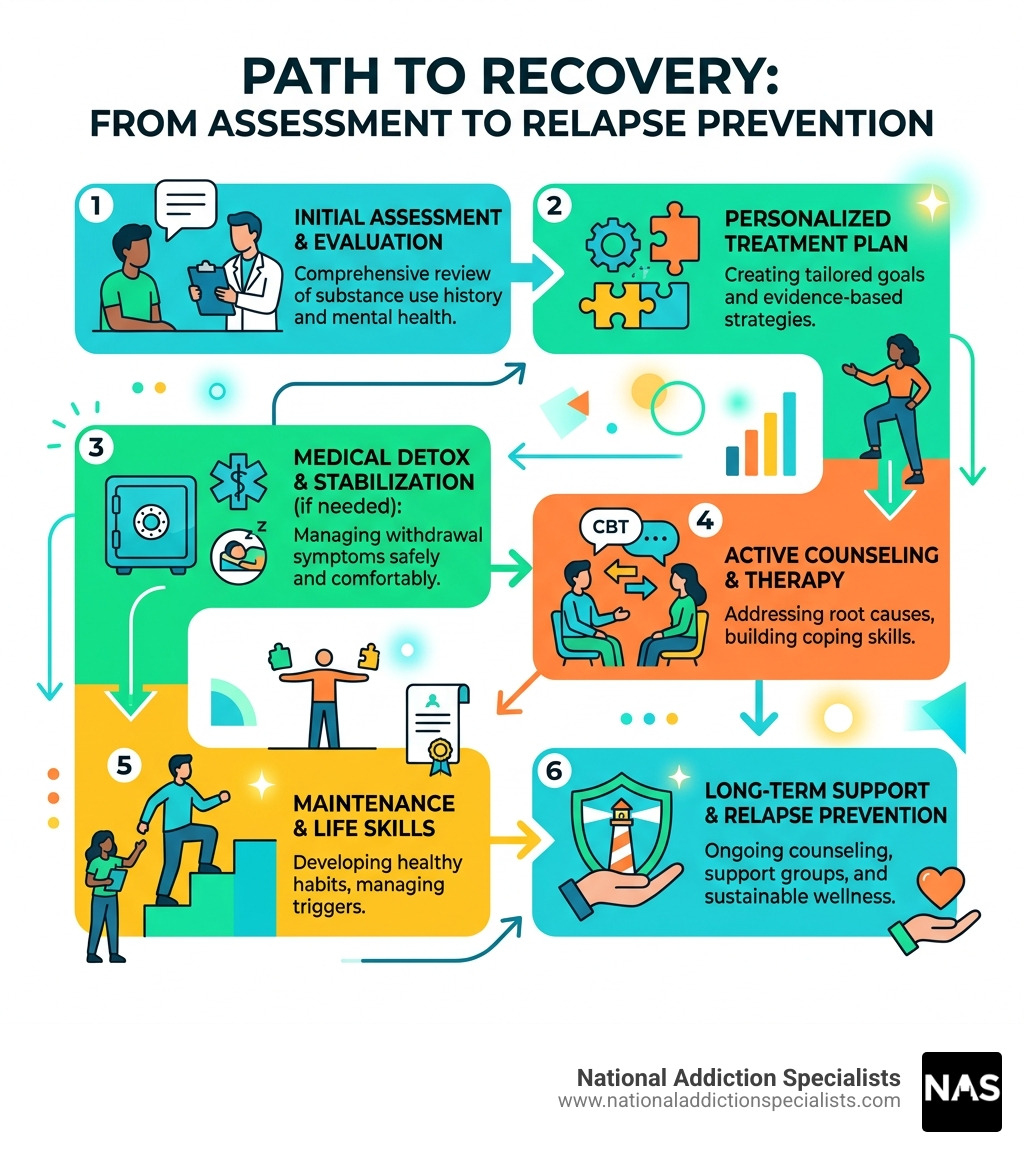
The first session is usually a “comprehensive assessment.” Your counselor will ask about your history, your health, and what you hope to achieve. It’s also a time for you to see if you “click” with the provider. A good counselor will set a pace that feels comfortable and non-judgmental.
How long does addiction counseling typically take?
Recovery is a marathon, not a sprint. While some people find stability in a few months, others benefit from ongoing support for a year or more. Remember the statistic: the five-year mark is a major milestone where the risk of relapse drops significantly. Your timeline will be personalized to your needs.
Can family members participate in counseling?
Absolutely. Addiction is often called a “family disease” because it affects everyone in the household. Family therapy helps repair broken trust, addresses codependency, and educates loved ones on how to provide healthy support rather than “enabling” behaviors.
Conclusion
Recovery is possible. With a 75 percent success rate for those who seek effective treatment, the odds are in your favor if you take the first step. Whether you choose in-person sessions in Virginia Beach or the convenience of our telemedicine Suboxone treatment at National Addiction Specialists, the goal is the same: a healthier, substance-free life.
If you are in Tennessee or Virginia and ready to start, we are here to help you schedule addiction treatment today.
This article was medically reviewed by: Chad Elkin, MD, DFASAM is a board-certified addiction medicine physician, founder, and Chief Medical Officer of National Addiction Specialists, dedicated to treating substance use disorders. A Distinguished Fellow of the American Society of Addiction Medicine (ASAM), Dr Elkin currently serves as President of the Tennessee Society of Addiction Medicine (TNSAM) and has held various leadership roles within the organization. Dr Elkin chairs ASAM’s Health Technology Subcommittee and is an active member of its Practice Management and Regulatory Affairs Committee, State Advocacy and Legislative Affairs Committee, and other committees. He also serves on the planning committee for the Vanderbilt Mid-South Addiction Conference. Committed to advancing evidence-based policy, Dr Elkin is Chairman of the Tennessee Association of Alcohol, Drug, & Other Addiction Services (TAADAS) Addiction Medicine Council, which collaborates with the TN Department of Mental Health & Substance Abuse Services (TDMHSAS). He has contributed to numerous local, state, and national task forces, helping develop professional guidelines, policies, and laws that align with best practices in addiction medicine. His work focuses on reducing addiction-related harm, combating stigma, and ensuring access to effective treatment. Passionate about the field of addiction medicine, he remains dedicated to shaping policy and enhancing patient care.
Suboxone® and Subutex® are a registered trademark of Indivior UK Limited. Any mention and reference of Suboxone® and Subutex® in this website is for informational purposes only and is not an endorsement or sponsorship by Indivior UK Limited.