Virginia Telemental Health 101 Your Guide to Virtual Care
Your Quick Guide to Telehealth Counseling in Virginia
Telehealth counseling Virginia residents can access today means licensed therapists and psychiatrists delivering mental health care via secure video or phone — no commute, no waiting room, no stigma.
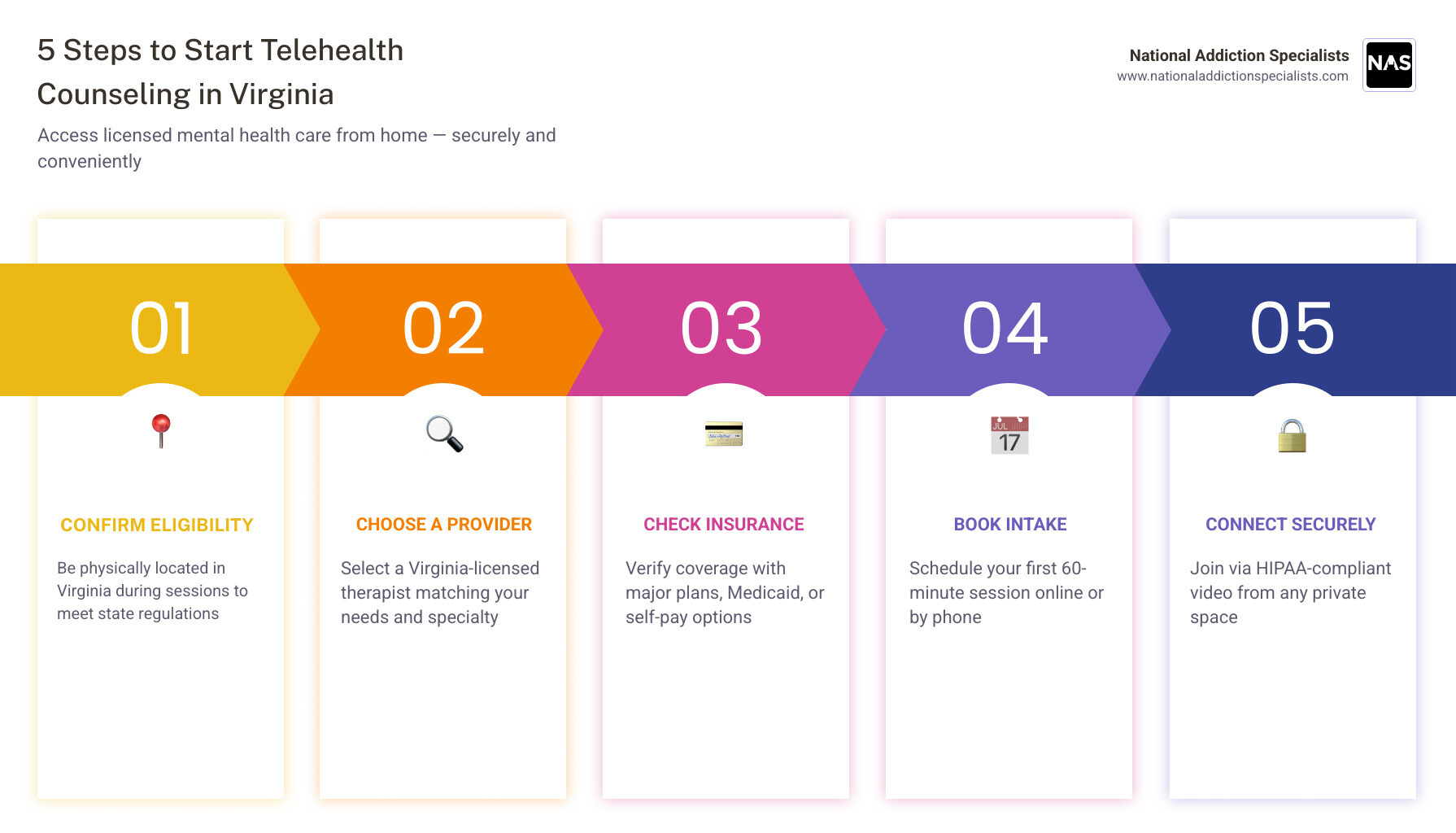
Here’s how to get started in 5 steps:
- Confirm eligibility — You must be physically located in Virginia during sessions
- Choose a provider — Find a Virginia-licensed therapist or counselor who fits your needs
- Check your insurance — Most major plans and Medicaid now cover telehealth services
- Book your intake — Schedule a first session (typically 60 minutes) online or by phone
- Connect securely — Join via a HIPAA-compliant video platform from any private space
Whether you’re managing anxiety, depression, trauma, or addiction, virtual care puts real clinical support within reach — from your home, on your schedule.
Getting mental health help used to mean taking time off work, arranging childcare, and sitting in a waiting room. For many Virginians — especially those in rural areas or dealing with the stigma of addiction — those barriers were enough to stop them from getting care at all.
That’s changed. Telehealth has made it possible to connect with a licensed mental health professional from anywhere in Virginia, using just a smartphone or laptop. And the research backs it up — a 2017 meta-analysis found that internet-based cognitive behavioral therapy (CBT) is effective for depression, generalized anxiety disorder, social anxiety, panic disorders, and phobias.
This guide walks you through everything you need to know: how it works, what it costs, what conditions it treats, and how to take your first step.
I’m Chad Elkin, MD — founder and Medical Director of National Addiction Specialists, board-certified in both Addiction Medicine and Internal Medicine, and licensed to practice in Virginia. My work in telehealth addiction services has shown me how telehealth counseling Virginia residents rely on can be a lifeline, particularly for those navigating opioid use disorder while managing work, family, and the fear of judgment. This guide reflects that clinical experience.
Simple Telehealth counseling Virginia glossary:
Understanding Telehealth Counseling Virginia
Telehealth counseling, also known as telemental health or virtual therapy, is the delivery of mental health services through electronic communications. In Virginia, this primarily happens via high-definition video conferencing, though audio-only sessions are sometimes used depending on the clinical need and insurance requirements.
At its core, telehealth counseling Virginia services function exactly like traditional office visits, just without the physical office. We use Telemedicine Treatment to bridge the gap between patients and providers, ensuring that high-quality care is accessible regardless of whether you live in the heart of Richmond or a remote part of the Blue Ridge Mountains.
Legal and Location Requirements
One of the most common questions we hear is: “Can I do therapy from anywhere?” While the technology allows for it, the law has specific rules. To receive telehealth counseling Virginia services, you must be physically located within the state of Virginia at the time of your session.
This is because clinical licenses are state-specific. A therapist must be licensed by the Virginia Department of Health Professions to treat a patient located in the Commonwealth. Even if you are a permanent resident of Virginia, if you are vacationing in North Carolina, your Virginia-based therapist generally cannot legally conduct a session with you until you return. This residency and location verification is a standard part of every virtual intake.
Furthermore, Telemedicine in Suboxone Treatment follows strict federal and state guidelines to ensure that medication-assisted treatment (MAT) is provided safely and legally through virtual platforms.
Technology and Privacy Standards
Privacy is a top priority in mental health. We don’t just use standard “FaceTime” or “Skype” for sessions. Virginia providers utilize HIPAA-compliant platforms, such as Zoom for Healthcare, which offer end-to-end encryption. This ensures that your private conversations remain just that—private.
When you book a session, you will typically receive a secure link via email or text. This link takes you to a “virtual waiting room.” Your provider then admits you to the session when they are ready. This digital setup prevents “zoom-bombing” and ensures that no one else can stumble into your session. If you run into technical glitches, most practices have clinical assistants or support teams ready to help you troubleshoot your connection or audio settings.
Benefits and Effectiveness of Virtual Therapy
The shift toward virtual care isn’t just about convenience; it’s about results. For many, the ability to sit on their own sofa, with a pet nearby or a cup of tea in hand, lowers the “barrier to entry” for therapy.
Is Telehealth Counseling Virginia as Effective as In-Person?
The short answer is: Yes. Extensive research, including a 2017 meta-analysis, has shown that internet-based therapy is just as effective as face-to-face sessions for a wide range of conditions, including depression and various anxiety disorders.
The “therapeutic rapport”—that feeling of connection and trust between you and your counselor—remains strong online. In fact, some patients find it easier to open up from the safety of their own homes. While there are some limitations (it can be harder for a therapist to see subtle body language like a tapping foot), the clinical outcomes are remarkably similar. For many Virginians, the “best” therapy is the one they can actually attend consistently, and telehealth makes consistency much easier.
Advantages for Busy Professionals and Parents
If you’re a professional in Northern Virginia dealing with a two-hour commute, or a parent in Virginia Beach juggling school schedules, finding time for a 60-minute office visit plus travel time can feel impossible.
Telehealth counseling Virginia solves this by:
- Eliminating Commutes: No more fighting I-95 traffic or searching for parking.
- Flexible Scheduling: Many virtual providers offer evening or weekend hours that traditional clinics might not.
- Privacy: You don’t have to worry about bumping into a neighbor or colleague in a local waiting room.
- Childcare Ease: Parents can often schedule sessions during a nap time or while children are occupied in another room, rather than hiring a sitter.
Conditions Treated and Therapeutic Approaches
Virtual care in Virginia is not a “watered-down” version of therapy. It covers the full spectrum of mental health and substance use needs.
Specialized Telehealth Counseling Virginia Services
We treat a wide variety of conditions through virtual platforms. Whether you are seeking Virtual Addiction Counseling or support for Counseling for Opioid Addiction, the approaches used are evidence-based and tailored to the individual.
Commonly offered therapeutic approaches include:
- Cognitive Behavioral Therapy (CBT): Focusing on changing negative thought patterns.
- Dialectical Behavior Therapy (DBT): Excellent for emotional regulation and distress tolerance.
- EMDR (Eye Movement Desensitization and Reprocessing): Often used for trauma, some Virginia providers now offer intensive virtual EMDR sessions.
- Online Addiction Counseling: Providing the same level of support as in-person groups or individual sessions.
- Telehealth Suboxone Treatment: Combining medication management with counseling for a holistic recovery plan.
Support for Veterans and Families
Virginia has a significant military and veteran population. Virtual therapy provides a vital link for those transitioning to civilian life or managing service-related PTSD. Specialized providers understand the unique challenges of military families and offer couples counseling and parenting strategies designed to bridge the distance, whether that distance is physical or emotional.
Getting Started: Insurance, Costs, and Booking
Taking the first step can feel daunting, but the process is designed to be user-friendly. Most Virginia practices offer online booking portals or simple phone intakes to get you started.
Coverage for Medicaid and Medicare
A major win for Virginia residents is that telehealth is now widely covered. Following the COVID-19 pandemic, most major private insurance plans (like Anthem, Aetna, and Cigna) have made virtual care a permanent part of their coverage.
Crucially, Addiction Counseling Services and general telemental health are often covered by Medicaid and Medicare in Virginia. If you don’t have insurance, many providers offer self-pay rates, which typically range from $90 to $170 per session depending on the provider’s experience level. Always check our Insurance and Pricing page to understand your specific options.
How to Prepare for Your First Session
Your first appointment is usually an intake assessment, lasting about 60 minutes. This is where you and your provider discuss your history, your goals, and your Counseling Program.
To make the most of it:
- Find a Private Space: Ensure you won’t be interrupted. A parked car can work in a pinch if your home is crowded!
- Test Your Tech: Check your internet speed and ensure your camera and microphone are working 15 minutes before the start time.
- Complete Paperwork: Most Virginia providers use digital “onboarding” packets. Having these done in advance saves valuable session time.
- Be Honest: Virtual care works best when you are open about your struggles and what you hope to achieve.
Make an Appointment to Treat Addiction Please don’t hesitate. Make an appointment today. Make an Appointment Now
Frequently Asked Questions about Virginia Virtual Care
Can telehealth therapists in Virginia prescribe medication?
Yes, but it depends on the type of provider. Licensed Professional Counselors (LPCs) and Social Workers (LCSWs) cannot prescribe medication. However, Psychiatrists and Psychiatric Mental Health Nurse Practitioners (PMHNPs) in Virginia can conduct evaluations and manage medications via telehealth.
For non-controlled substances, this is very straightforward. For controlled substances (like certain ADHD medications or Suboxone), there are specific federal and state regulations regarding “in-person” requirements that may apply, though many of these have been modernized to allow for continued virtual access.
What are the limitations of online counseling?
While highly effective, telehealth isn’t for everyone. It may not be suitable for:
- Individuals in active crisis or experiencing suicidal thoughts (who need immediate, in-person emergency intervention).
- Those with severe, unstable psychiatric disorders that require intensive on-site monitoring.
- People without access to a private space or a stable internet connection.
- Young children who may require the tactile nature of “play therapy” which is difficult to replicate over video.
How do I find a licensed Virginia provider?
You can use directories like Psychology Today or your insurance provider’s “Find a Doctor” tool. Look for providers who specifically mention they are licensed in Virginia and offer HIPAA-compliant video sessions. Many practices offer a free 15-minute consultation to see if the therapist is a good fit for your personality and needs.
Conclusion
The evolution of telehealth counseling Virginia has opened doors that were previously locked for many residents. At National Addiction Specialists, we are proud to offer personalized, confidential recovery plans that respect your time and your privacy. Whether you are in Brentwood, TN, or Virginia Beach, VA, our goal is to provide expert care that meets you exactly where you are.
If you’re ready to reclaim your wellness, the tools are already in your hands.
This article was medically reviewed by: Chad Elkin, MD, DFASAM is a board-certified addiction medicine physician, founder, and Chief Medical Officer of National Addiction Specialists, dedicated to treating substance use disorders. A Distinguished Fellow of the American Society of Addiction Medicine (ASAM), Dr Elkin currently serves as President of the Tennessee Society of Addiction Medicine (TNSAM) and has held various leadership roles within the organization. Dr Elkin chairs ASAM’s Health Technology Subcommittee and is an active member of its Practice Management and Regulatory Affairs Committee, State Advocacy and Legislative Affairs Committee, and other committees. He also serves on the planning committee for the Vanderbilt Mid-South Addiction Conference. Committed to advancing evidence-based policy, Dr Elkin is Chairman of the Tennessee Association of Alcohol, Drug, & Other Addiction Services (TAADAS) Addiction Medicine Council, which collaborates with the TN Department of Mental Health & Substance Abuse Services (TDMHSAS). He has contributed to numerous local, state, and national task forces, helping develop professional guidelines, policies, and laws that align with best practices in addiction medicine. His work focuses on reducing addiction-related harm, combating stigma, and ensuring access to effective treatment. Passionate about the field of addiction medicine, he remains dedicated to shaping policy and enhancing patient care.
Suboxone® and Subutex® are a registered trademark of Indivior UK Limited. Any mention and reference of Suboxone® and Subutex® in this website is for informational purposes only and is not an endorsement or sponsorship by Indivior UK Limited.