
The Clock on Delirium Tremens and What to Expect
The Clock on Delirium Tremens: What the Timeline Really Looks Like
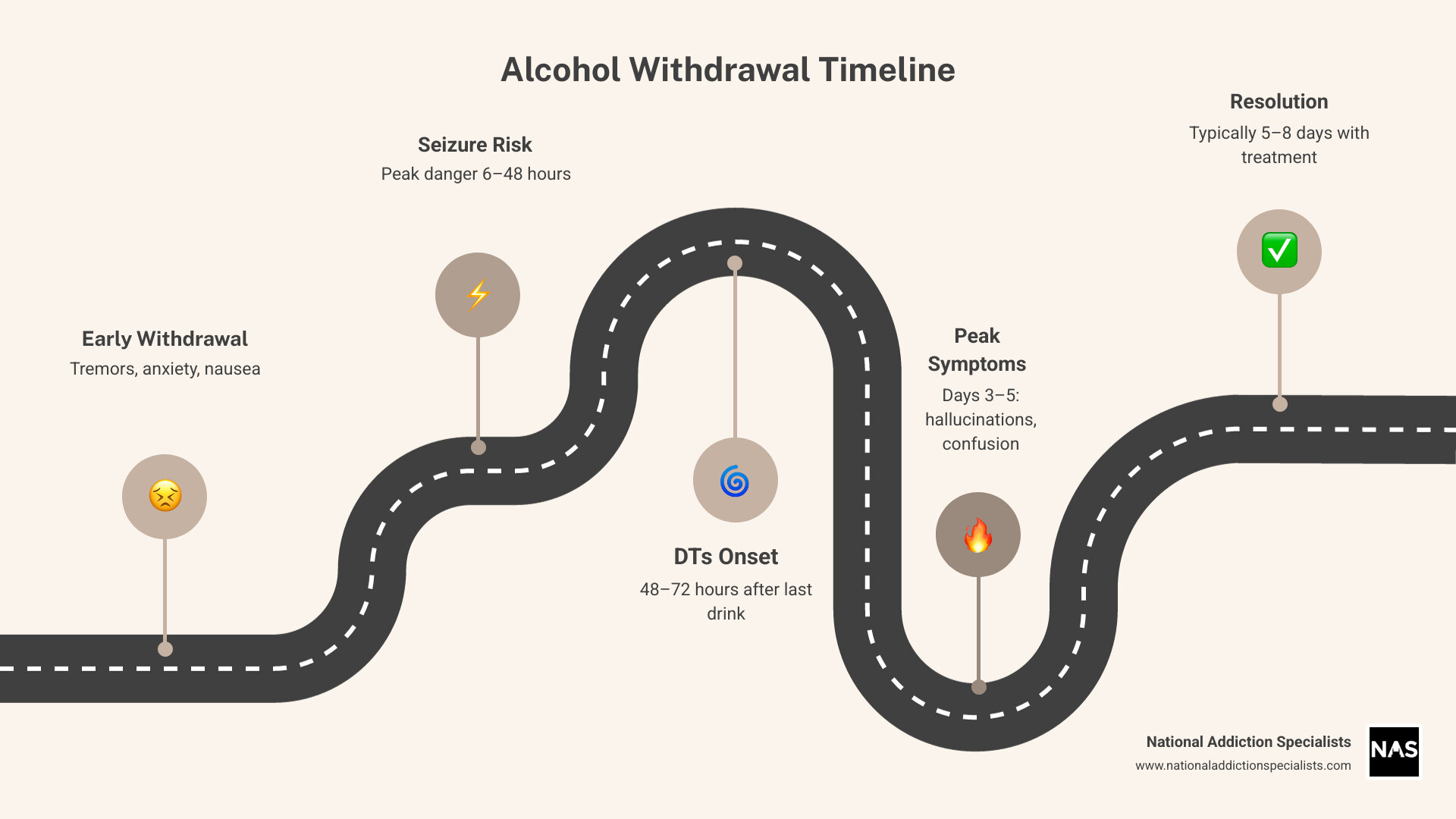
Delirium tremens duration is typically 1 to 8 days, with symptoms usually beginning 48 to 72 hours after the last drink and peaking around days 3 to 5.
| Phase | Timing After Last Drink |
|---|---|
| Early withdrawal (tremors, anxiety) | 6–24 hours |
| Seizure risk window | 6–48 hours |
| DTs onset | 48–72 hours (up to 7–10 days in some cases) |
| Peak symptoms | Days 3–5 |
| Typical resolution | Within 5–8 days |
| Rare prolonged cases | Up to several weeks |
Most people who develop delirium tremens (DTs) don’t see it coming. You stop drinking, feel okay for a day or two — and then your body goes into crisis mode. Confusion. Hallucinations. A racing heart. Shaking so severe you can’t hold a cup.
DTs is not just a bad hangover. It’s a medical emergency.
It’s the most severe form of alcohol withdrawal, and without proper treatment, it can be fatal. Historically, up to 25–40% of untreated cases ended in death. Even today, with modern medicine, mortality remains around 1–5% — and higher in cases that aren’t caught early.
Understanding how long DTs lasts, and what drives that timeline, can be the difference between life and death.
I’m Dr. Chad Elkin, Founder and Medical Director of National Addiction Specialists, board-certified in both Addiction Medicine and Internal Medicine — and the question of delirium tremens duration sits squarely at the intersection of the life-threatening withdrawal cases I’ve managed throughout my career. Understanding this timeline is essential to everything we do in evidence-based addiction care.
Understanding Delirium Tremens and Its Onset
To understand why the delirium tremens duration can be so unpredictable, we have to look at what alcohol does to the brain over time. Think of the brain like a car. When you drink heavily and chronically, alcohol acts as a powerful “brake” on your central nervous system. It enhances the activity of GABA, the primary inhibitory (calming) neurotransmitter, and suppresses glutamate, the primary excitatory (stimulating) neurotransmitter.
To keep the “car” moving, your brain adapts by cranking up the “engine.” It produces more glutamate and reduces its sensitivity to GABA. When you suddenly take your foot off the brake (stop drinking), that engine is still revving at max speed. The result is a massive surge of glutamate and a lack of GABA to balance it out. This leads to profound hyperexcitability and neurotoxicity.
This neurochemical storm manifests as autonomic instability—your heart rate spikes, your blood pressure soars, and your body temperature rises dangerously. According to scientific research on recognition and management, this state of “sympathetic overdrive” is what makes DTs a true medical crisis.
How DTs Differ from Standard Alcohol Withdrawal
It is a common misconception that all withdrawal is the same. In reality, withdrawal exists on a spectrum. About 50% of people with alcohol use disorder will experience some withdrawal symptoms, but only about 3% to 5% will progress to full-blown delirium tremens.
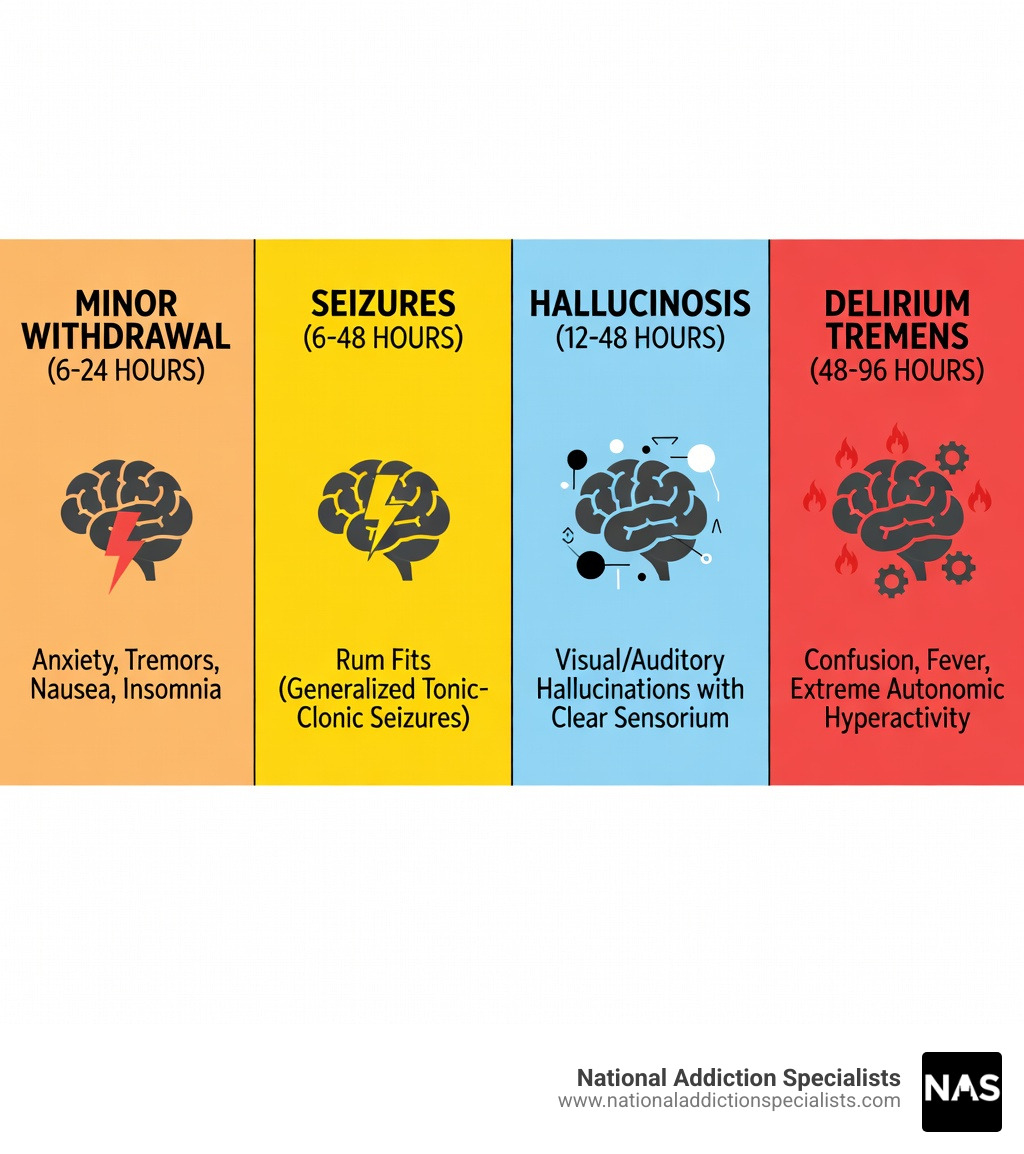
Standard withdrawal usually involves “the shakes” (tremors), anxiety, and nausea. You might even experience “rum fits”—generalized tonic-clonic seizures that typically occur 6 to 48 hours after the last drink. While frightening, these are not the same as DTs.
The defining feature of DTs is delirium—a profound state of confusion and disorientation. Unlike “alcoholic hallucinosis,” where a person might hear voices but knows where they are, a person in DTs is often “immersed” in their hallucinations. They might believe they are in a different room or interacting with objects that aren’t there.
While we often focus on alcohol, it’s important to note that other substances have their own withdrawal complexities. For instance, you can find more info about opioid withdrawal to see how different those timelines and symptoms can be. In DTs, however, the primary danger is the total loss of control over vital signs and mental status.
The Typical Delirium Tremens Duration and Timeline
When we talk about the delirium tremens duration, we are looking at a window that usually opens 48 to 72 hours after the last drink. It is often preceded by a “window of lucidity” where the patient seems to be recovering from early withdrawal, only to suddenly crash into delirium.
The Stages of the Clock
- Onset (48–72 Hours): The transition from simple withdrawal to DTs. Confusion sets in, and autonomic symptoms (sweating, high heart rate) become severe.
- The Peak (Days 3–5): This is the most dangerous period. Hallucinations are most intense, and the risk of cardiac arrhythmia or circulatory collapse is at its highest.
- Resolution (Days 5–8): In 62% of cases, symptoms resolve within 5 days. The patient often falls into a deep, long sleep and wakes up with a clear mind, though physically exhausted.
Factors Influencing Delirium Tremens Duration
Why does one person recover in two days while another struggles for a week? Several biological factors play a role:
- Liver Function: If the liver is damaged (cirrhosis or hepatitis), it cannot process medications or metabolic byproducts efficiently, potentially extending the delirium.
- Age: Older patients generally have less “cognitive reserve” and may experience longer periods of confusion.
- Co-morbidities: Concurrent infections, head injuries, or electrolyte imbalances (like low potassium or magnesium) can significantly complicate and lengthen the course.
- Hydration and Nutrition: Severe dehydration—common in heavy drinkers—can lead to kidney issues that slow down recovery.
When Delirium Tremens Duration Becomes Prolonged
In rare instances, we encounter what is known as refractory DTs. This is defined as a failure to control symptoms despite massive doses of sedatives (like more than 40 mg of lorazepam in a few hours).
A notable case study detailed a patient who experienced 28-day-long delirium tremens. This patient required an escalating regimen of high-dose benzodiazepines, a midazolam infusion, and eventually phenobarbital to stabilize. This case highlights that while the 1–8 day window is the norm, we must remain vigilant for outliers who require intensive care and multi-drug interventions for weeks.
Risk Factors and Diagnosis of Severe Withdrawal
Identifying who is at risk for a long delirium tremens duration is a priority in clinical settings. The biggest red flag is a history of previous DTs or withdrawal seizures. The brain “remembers” withdrawal, and each subsequent episode tends to be more severe—a phenomenon known as “kindling.”
Other risk factors include:
- Drinking the equivalent of a pint of liquor or several liters of beer/wine daily for months.
- Being over the age of 30.
- Having a concurrent illness or infection (which “distracts” the body’s ability to heal).
- High CIWA-Ar scores (Clinical Institute Withdrawal Assessment for Alcohol). A score greater than 15 is a strong predictor of impending DTs.
Diagnosis is primarily clinical, meaning we look at the symptoms and history. However, we also use lab tests to rule out “mimics” like meningitis, sepsis, or Wernicke’s encephalopathy. Doctors will monitor for tachycardia (heart rate over 120–150 bpm) and hypertension as key indicators of severity. You can read a more clinical review of DT studies to see how these diagnostic tools have evolved.
Standard Treatment Protocols and Prevention
Because of the high mortality risk, DTs must be treated in a hospital, often in the ICU. The goal is simple: keep the patient sedated, hydrated, and safe until the storm passes.
The Medication Toolkit
- Benzodiazepines: Drugs like diazepam (Valium) or lorazepam (Ativan) are the gold standard. They “replace” the missing alcohol at the GABA receptors to calm the brain.
- Thiamine (Vitamin B1): This is crucial. Chronic alcohol use depletes thiamine, and giving glucose without thiamine can trigger Wernicke’s encephalopathy, a permanent form of brain damage.
- Fluid Resuscitation: Patients in DTs can be up to 10 liters fluid-deficient due to sweating, fever, and vomiting.
- Magnesium and Electrolytes: These help stabilize the heart and prevent seizures.
Modern Approaches to Managing Delirium Tremens Duration
In recent years, we have seen a shift toward using phenobarbital—a barbiturate—either instead of or alongside benzodiazepines. Research suggests that phenobarbital may lead to a shorter delirium tremens duration and fewer ICU admissions because it acts on the GABA receptor differently and also suppresses glutamate.
We also use “symptom-triggered dosing.” Instead of giving a pill every four hours, we monitor the patient and give medication only when their symptoms (like heart rate or agitation) reach a certain threshold. This prevents over-sedation and helps the patient recover faster.
Make an Appointment to Treat Addiction Please don’t hesitate. Make an appointment today. https://www.nationaladdictionspecialists.com/new-patient-packet/
Frequently Asked Questions about DTs
Can delirium tremens be fatal without treatment?
Yes. Without medical intervention, the mortality rate can be as high as 37%. Death usually occurs due to hyperthermia (overheating), cardiac arrhythmias (irregular heartbeat leading to heart attack), or respiratory failure. Modern medicine has brought this down to under 5%, but it remains a very dangerous condition.
What are the “pink elephants” associated with DTs?
“Seeing pink elephants” is a classic euphemism for the visual hallucinations of DTs. While elephants are rare, patients often report seeing small, moving objects like insects, spiders, or snakes. This is sometimes called “formication”—the sensation of bugs crawling on the skin. These hallucinations are a result of the brain’s visual processing centers being overstimulated.
How can I prevent DTs during detox?
The only way to safely prevent DTs is through medical supervision. If you have been a heavy, daily drinker for a long time, do not try to quit “cold turkey” at home. A doctor can provide a gradual tapering schedule or prophylactic medications (like chlordiazepoxide) to help your brain adjust slowly, effectively “short-circuiting” the DT process before it starts.
Conclusion
The delirium tremens duration may only be a few days on the calendar, but for the person experiencing it, it is a harrowing, life-altering event. It is a stark reminder of how much alcohol can change the brain’s chemistry.
At National Addiction Specialists, we believe that no one should have to face the fear of withdrawal alone. While we specialize in telemedicine-based Suboxone treatment for opioid addiction in Tennessee and Virginia, our mission is rooted in the same evidence-based, compassionate care required to treat any substance use disorder. We offer personalized recovery plans from the comfort of your home, ensuring that your path to sobriety is as safe and convenient as possible.
If you or a loved one are struggling with alcohol or opioids, help is available. Whether it’s through Medicaid, Medicare, or private insurance, we are here to support your journey.
For more information on how we can help you navigate the road to recovery, visit our insurance and pricing page or explore our full range of services.
This article was medically reviewed by: Chad Elkin, MD, DFASAM is a board-certified addiction medicine physician, founder, and Chief Medical Officer of National Addiction Specialists, dedicated to treating substance use disorders. A Distinguished Fellow of the American Society of Addiction Medicine (ASAM), Dr Elkin currently serves as President of the Tennessee Society of Addiction Medicine (TNSAM) and has held various leadership roles within the organization. Dr Elkin chairs ASAM’s Health Technology Subcommittee and is an active member of its Practice Management and Regulatory Affairs Committee, State Advocacy and Legislative Affairs Committee, and other committees. He also serves on the planning committee for the Vanderbilt Mid-South Addiction Conference. Committed to advancing evidence-based policy, Dr Elkin is Chairman of the Tennessee Association of Alcohol, Drug, & Other Addiction Services (TAADAS) Addiction Medicine Council, which collaborates with the TN Department of Mental Health & Substance Abuse Services (TDMHSAS). He has contributed to numerous local, state, and national task forces, helping develop professional guidelines, policies, and laws that align with best practices in addiction medicine. His work focuses on reducing addiction-related harm, combating stigma, and ensuring access to effective treatment. Passionate about the field of addiction medicine, he remains dedicated to shaping policy and enhancing patient care.
Suboxone® and Subutex® are a registered trademark of Indivior UK Limited. Any mention and reference of Suboxone® and Subutex® in this website is for informational purposes only and is not an endorsement or sponsorship by Indivior UK Limited.