How We Can Solve the Opioid Crisis Together
The Opioid Crisis Is Solvable — Here’s What Actually Works
Opioid crisis solutions exist, and they are backed by evidence. Here is a quick overview of the most effective approaches:
- Medications for Opioid Use Disorder (MOUD) – Buprenorphine, methadone, and naltrexone reduce cravings, prevent overdose, and support long-term recovery
- Telehealth treatment – Connects patients to addiction specialists from home, improving retention and reducing fatal overdose risk
- Harm reduction – Naloxone distribution, fentanyl test strips, and syringe services programs save lives right now
- Community programs – Coordinated local efforts, like Project Lazarus, have cut overdose death rates by as much as 38% in a single year
- Policy reform – Expanding MOUD access, enforcing parity laws, and addressing social determinants like housing and employment
- Prescription monitoring and supply controls – Prescription Drug Monitoring Programs (PDMPs) and drug take-back initiatives reduce misuse at the source
More than 105,000 Americans died from opioid overdoses in 2023 alone. That is not a statistic about strangers. It is neighbors, parents, coworkers, and friends. Since 1999, over a million people in the United States have lost their lives to drug overdoses — a toll that now surpasses the combined American deaths in both World Wars.
And yet, for all the devastation, this crisis is not unsolvable.
The science is clear. The tools exist. What has been missing is coordinated, stigma-free action — across healthcare systems, communities, and policy — to put those tools into the hands of people who need them.
I’m Dr. Chad Elkin, founder and Medical Director of National Addiction Specialists and a board-certified Addiction Medicine physician. Having dedicated my career to developing accessible, telehealth-based opioid crisis solutions for patients in Tennessee, Virginia, and beyond, I’ve seen what works — and what gets in the way.
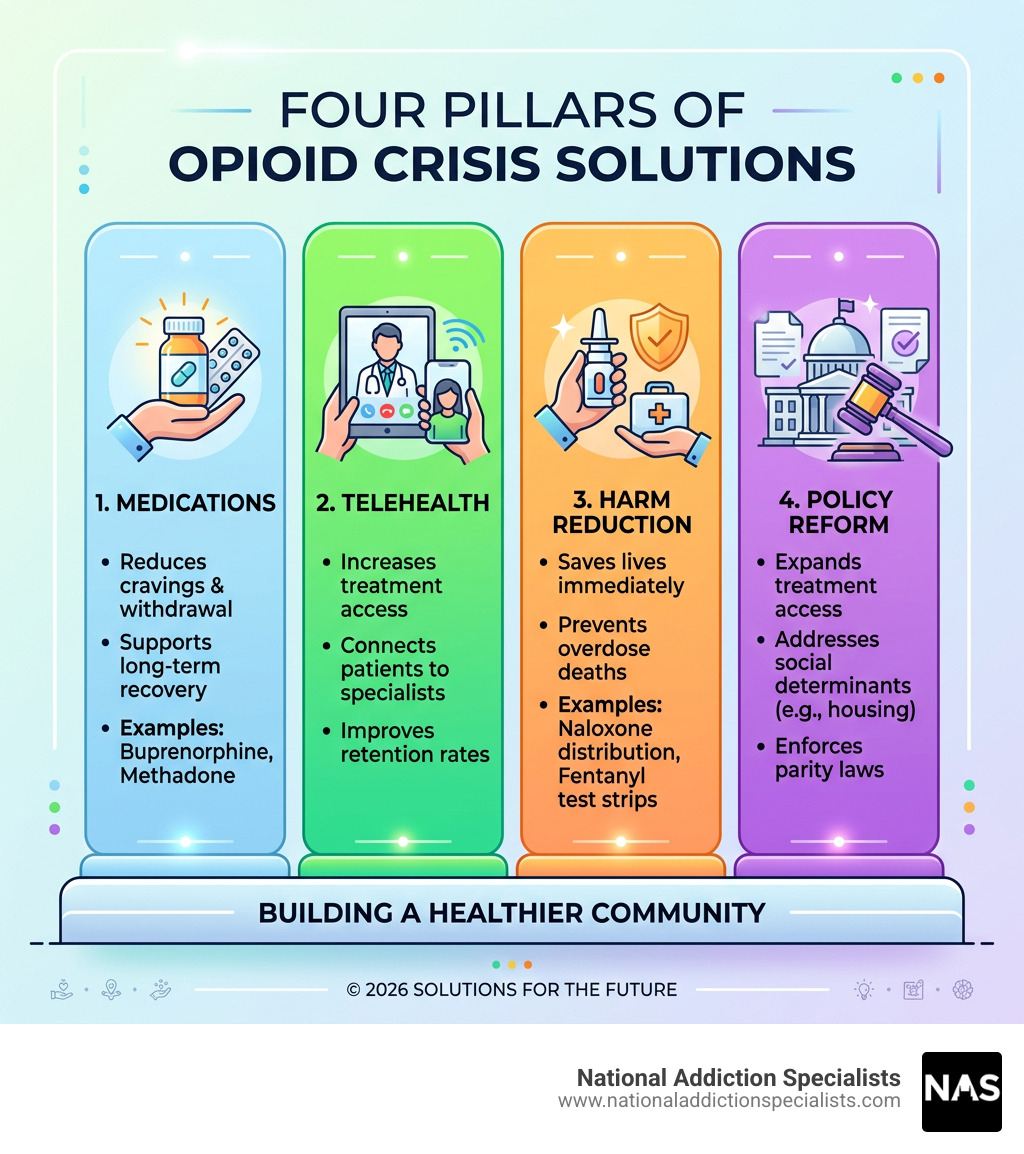
Simple guide to Opioid crisis solutions:
Understanding the Evolution of the Epidemic
To find the right opioid crisis solutions, we first have to understand how we got here. Experts generally agree that the crisis has moved through three distinct, overlapping waves, with a fourth currently emerging.
The first wave began in the 1990s, driven by a massive increase in the prescription of opioids for chronic pain. Marketing campaigns downplayed the risks of addiction, leading to a surge in deaths involving natural and semi-synthetic opioids. Research into opioid-prescribing patterns shows that even a single prescription from an emergency department can significantly increase the risk of long-term use.
The second wave arrived around 2010, as many people who had become dependent on pills transitioned to heroin, which was often cheaper and easier to find. By 2013, the third wave hit like a tidal wave: synthetic opioids, primarily illicitly manufactured fentanyl. Today, synthetic opioids are the leading driver of drug overdose deaths, accounting for about 70% of all opioid-related fatalities.
We are now seeing a fourth wave characterized by illicit mixtures—fentanyl being pressed into fake pills or mixed with stimulants like cocaine and methamphetamine. This makes the drug supply more unpredictable and deadly than ever before.
| Opioid Type | Mortality Trend (1999–Present) | Primary Driver |
|---|---|---|
| Prescription Opioids | Steady increase, now plateauing | Over-prescribing, “Pill Mills” |
| Heroin | Sharp spike 2010–2016, now declining | Market substitution |
| Synthetic (Fentanyl) | Exponential growth since 2013 | Illicit manufacturing, high potency |
The sheer scale is staggering: nearly 727,000 people have died from opioid-involved overdoses since the epidemic began. However, there is a glimmer of hope. Provisional data shows that overdose deaths began to decrease in 2023 for the first time since 2018, proving that our collective efforts are starting to move the needle.
Evidence-Based Opioid Crisis Solutions
When we talk about “solving” addiction, we have to treat it for what it is: a chronic, relapsing brain disease, not a moral failure. The gold standard for Opioid Addiction Treatment is Medication for Opioid Use Disorder (MOUD).
MOUD works by normalizing brain chemistry, blocking the euphoric effects of opioids, and relieving the intense physical cravings that often lead to relapse. By using Suboxone for Opioid Addiction, patients can stabilize their lives, return to work, and rebuild relationships without the constant shadow of withdrawal.

Implementing Medical Opioid Crisis Solutions
The three FDA-approved medications for OUD are buprenorphine (the active ingredient in Suboxone), methadone, and naltrexone.
- Buprenorphine: A partial agonist that suppresses withdrawal and cravings. It is unique because it can be prescribed by qualified clinicians in office-based settings or via telehealth, making it one of the most accessible opioid crisis solutions.
- Methadone: A full agonist that has been used for decades. It must be dispensed through federally regulated Opioid Treatment Programs (OTPs).
- Naltrexone: An antagonist that blocks opioid receptors entirely. It requires a patient to be opioid-free for 7–10 days before starting.
At National Addiction Specialists, we focus on Medication Assisted Treatment because it provides the biological foundation for recovery. When the brain is no longer in a state of crisis, the real work of healing can begin.
Scaling Behavioral Opioid Crisis Solutions
Medication is the foundation, but counseling is the structure built upon it. Counseling for Opioid Addiction helps individuals identify the triggers that lead to use and develop healthy coping mechanisms.
Cognitive Behavioral Therapy (CBT) and peer support are particularly effective. These behavioral interventions, when paired with MOUD, significantly increase the likelihood that a person will stay in treatment and avoid the risk of a fatal overdose.
Leveraging Technology and Broadband for Access
In many parts of Tennessee and Virginia, the biggest barrier to recovery isn’t a lack of will—it’s a lack of a ride. Rural areas often face severe shortages of addiction specialists, and the nearest clinic might be hours away.
This is where broadband connectivity becomes a literal lifeline. Telehealth Suboxone Treatment allows us to bring the clinic to the patient. Recent research on telehealth retention shows that individuals using virtual services are actually more likely to stay in treatment compared to those relying solely on in-person visits.
Beyond appointments, broadband enables:
- Crisis Hotlines: SAMHSA’s National Helpline received 833,598 calls in 2020, providing immediate support to those in need.
- Digital Interventions: Apps that complement treatment can track pain levels and log triggers, reducing the risk of relapse.
- Resource Access: High-speed internet helps those in recovery find housing and employment, which are essential for long-term stability.
For our neighbors in rural Tennessee and Virginia, telehealth isn’t just a convenience; it’s the bridge over a “treatment desert.”
Community-Led Prevention and Harm Reduction
We cannot wait for people to hit “rock bottom” to help them. We must meet them where they are. Harm reduction is a compassionate, pragmatic pillar of opioid crisis solutions that focuses on keeping people alive long enough to find recovery.
One of the most successful community models is Project Lazarus in North Carolina. By coordinating law enforcement, medical providers, and community members, they lowered the overdose death rate in one county by 38% in just one year. Similarly, the CeaseFire model, originally designed to reduce gang violence, has been adapted to treat addiction as a public health issue through community mobilization.
Effective harm reduction strategies include:
- Naloxone (Narcan) Distribution: This easy-to-use nasal spray can reverse an overdose in minutes.
- Fentanyl Test Strips: These allow individuals to check if their supply is contaminated with lethal synthetics.
- Syringe Services Programs (SSPs): These reduce the spread of infectious diseases like HIV and Hepatitis C and serve as a “warm hand-off” to treatment services.
- Good Samaritan Laws: These protect people who call for help during an overdose from drug possession charges, encouraging life-saving action.
Prevention also starts in the doctor’s office. Prescription Drug Monitoring Programs (PDMPs) help clinicians identify at-risk patients, while non-opioid pain management (using alternatives like Toradol or physical therapy) prevents addiction before it starts. In fact, some studies show Toradol can be more effective than morphine for certain types of acute pain without the risk of dependency.
Policy Reform and Addressing Social Determinants
The opioid crisis is often called a “crisis of despair.” It thrives in places where jobs are scarce, housing is unstable, and poverty is high. These “social determinants of health” play a massive role in fueling addiction. Scientific research on social determinants suggests that until we address economic insecurity, we are only treating the symptoms of a deeper societal wound.
Policy changes are moving in the right direction. The Biden administration invested over $5 billion through the American Rescue Plan to expand mental health care and addiction treatment. However, we need more:
- Criminal Justice Reform: Programs like Law Enforcement Assisted Diversion (LEAD) move people into treatment instead of jail. In Seattle, LEAD reduced recidivism by 58%.
- Border Security: While most fentanyl is trafficked through legal ports of entry by U.S. citizens, we must continue targeting the international brokers in China and Mexico who provide precursor chemicals.
- Reentry Support: The risk of overdose is highest in the first two weeks after release from prison. Providing MOUD behind bars and during reentry is a critical life-saving measure.
Frequently Asked Questions about Opioid Crisis Solutions
What are the most effective medications for treating opioid use disorder?
The most effective medications are buprenorphine (Suboxone), methadone, and naltrexone. Buprenorphine and methadone are “opioid agonists,” meaning they satisfy the brain’s physical need for opioids without the “high,” allowing the person to function normally. These medications are proven to reduce mortality by up to 50%.
How does telehealth improve outcomes for those in recovery?
Telehealth removes the biggest barriers to care: transportation, time off work, and childcare. By making it easier to attend appointments, telehealth increases treatment retention. It also reduces the stigma of sitting in a waiting room, allowing patients to receive confidential care from the privacy of their own homes.
What role do social determinants like housing play in addiction?
Stable housing is often the “linchpin” of recovery. It is incredibly difficult to maintain a treatment regimen while experiencing homelessness. When we provide “Housing First” models—giving people a safe place to live before requiring total abstinence—we see much better long-term health outcomes.
Conclusion
The path out of the opioid crisis requires us to work together. It requires doctors who provide evidence-based care, communities that offer support instead of shame, and policies that prioritize health over punishment.
At National Addiction Specialists, we are proud to be part of the solution for families across Tennessee and Virginia. Our telemedicine-based Suboxone treatment is designed to be convenient, confidential, and expert-led. We accept Medicaid and Medicare because we believe that lifesaving care should be accessible to everyone, regardless of their zip code or income.
Recovery is possible. We see it every day. If you or a loved one is struggling, please know that you don’t have to face this alone.
Medication Assisted Treatment for Opioid Addiction
Make an Appointment to Treat Addiction
Please don’t hesitate. Make an appointment today.
https://www.nationaladdictionspecialists.com/new-patient-packet/
This article was medically reviewed by: Chad Elkin, MD, DFASAM is a board-certified addiction medicine physician, founder, and Chief Medical Officer of National Addiction Specialists, dedicated to treating substance use disorders. A Distinguished Fellow of the American Society of Addiction Medicine (ASAM), Dr Elkin currently serves as President of the Tennessee Society of Addiction Medicine (TNSAM) and has held various leadership roles within the organization. Dr Elkin chairs ASAM’s Health Technology Subcommittee and is an active member of its Practice Management and Regulatory Affairs Committee, State Advocacy and Legislative Affairs Committee, and other committees. He also serves on the planning committee for the Vanderbilt Mid-South Addiction Conference. Committed to advancing evidence-based policy, Dr Elkin is Chairman of the Tennessee Association of Alcohol, Drug, & Other Addiction Services (TAADAS) Addiction Medicine Council, which collaborates with the TN Department of Mental Health & Substance Abuse Services (TDMHSAS). He has contributed to numerous local, state, and national task forces, helping develop professional guidelines, policies, and laws that align with best practices in addiction medicine. His work focuses on reducing addiction-related harm, combating stigma, and ensuring access to effective treatment. Passionate about the field of addiction medicine, he remains dedicated to shaping policy and enhancing patient care.
Suboxone® and Subutex® are a registered trademark of Indivior UK Limited. Any mention and reference of Suboxone® and Subutex® in this website is for informational purposes only and is not an endorsement or sponsorship by Indivior UK Limited.