An Essential Guide to Suboxone for Kratom Dependence
Can Suboxone Help with Kratom Dependence? Here’s What You Need to Know
Can Suboxone help with kratom dependence? Yes — and here’s the short answer before we go deeper:
| Question | Quick Answer |
|---|---|
| Does Suboxone work for kratom withdrawal? | Yes, based on case reports and clinical experience |
| Is it FDA-approved for kratom? | No — it is off-label use |
| When can you start Suboxone after kratom? | As early as 8–12 hours after your last dose |
| Do you need a prescription? | Yes, always under medical supervision |
| Is it right for everyone? | No — severity of use and health history matter |
Kratom is often sold as a “natural” remedy for pain, low energy, or even opioid withdrawal. But for many people, regular use quietly turns into dependence — and stopping becomes harder than expected. And now in Tennessee, Kratom will become illegal on July 1, 2026.
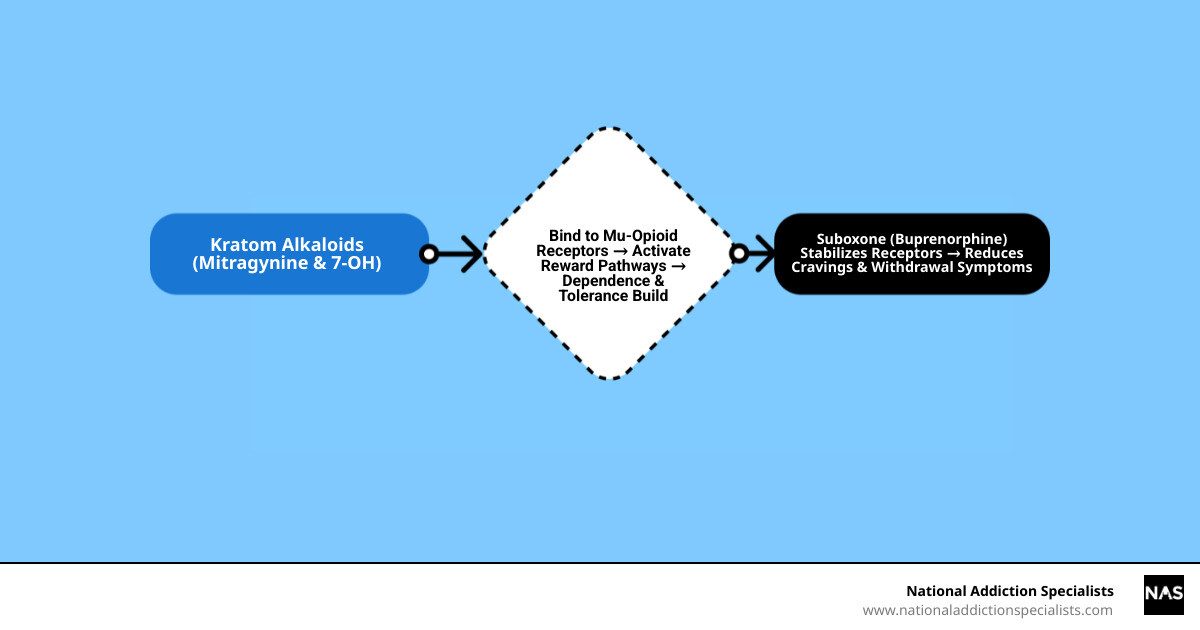
That’s because kratom’s active compounds, especially 7-hydroxymitragynine (7-OH), bind to the same opioid receptors in the brain as drugs like heroin and oxycodone. When you stop using it, your brain reacts the same way it would to opioid withdrawal — with anxiety, muscle aches, insomnia, and intense cravings. Withdrawal can also last far longer than typical opioid withdrawal — up to three months in some cases.
This is exactly why many clinicians are turning to Suboxone (buprenorphine/naloxone) as a treatment option. It’s not a perfect fix, and it’s not right for every situation — but the evidence is growing.
I’m Dr. Chad Elkin, board-certified in Addiction Medicine and founder of National Addiction Specialists, and I’ve worked directly with patients navigating Suboxone for kratom dependence as part of comprehensive, telemedicine-based care. In this guide, I’ll walk you through what the evidence actually says — and what a safe, supervised path forward looks like.
Can Suboxone Help with Kratom Dependence terms to know:
Understanding Kratom and Why It Leads to Dependence
To understand why someone might need Suboxone, we first have to look at what kratom actually does to the brain. Kratom (Mitragyna speciosa) contains over 40 alkaloids, but the two heavy hitters are mitragynine and 7-hydroxymitragynine (7-OH).
In low doses, kratom acts like a stimulant, giving you a boost of energy. But at higher doses, it behaves much more like a traditional opioid. It targets the mu-opioid receptors, which are the same “locks” that drugs like morphine or fentanyl turn. According to our Everything You Need To Know About Kratom guide, 7-OH is particularly potent—some studies suggest it is up to 13 times more potent than morphine.
Because kratom hits these receptors, your brain eventually decides it doesn’t need to produce its own feel-good chemicals anymore. This is how tolerance starts. You need more kratom to feel “normal,” and if you stop, your brain goes into a tailspin. This is the definition of dependence.
As noted in Kratom and Suboxone — What You Should Know, the withdrawal symptoms are no joke. We’re talking about:
- Severe muscle aches and “creepy-crawly” skin sensations.
- Intense anxiety and irritability.
- Nausea, vomiting, and diarrhea.
- Profound insomnia.
While often marketed as safe because it is a plant, the FDA reported in 2017 that kratom was associated with 440 deaths in a single year. While many of those involved other substances, it highlights that kratom is a powerful drug of concern.
Can Suboxone Help with Kratom Dependence?
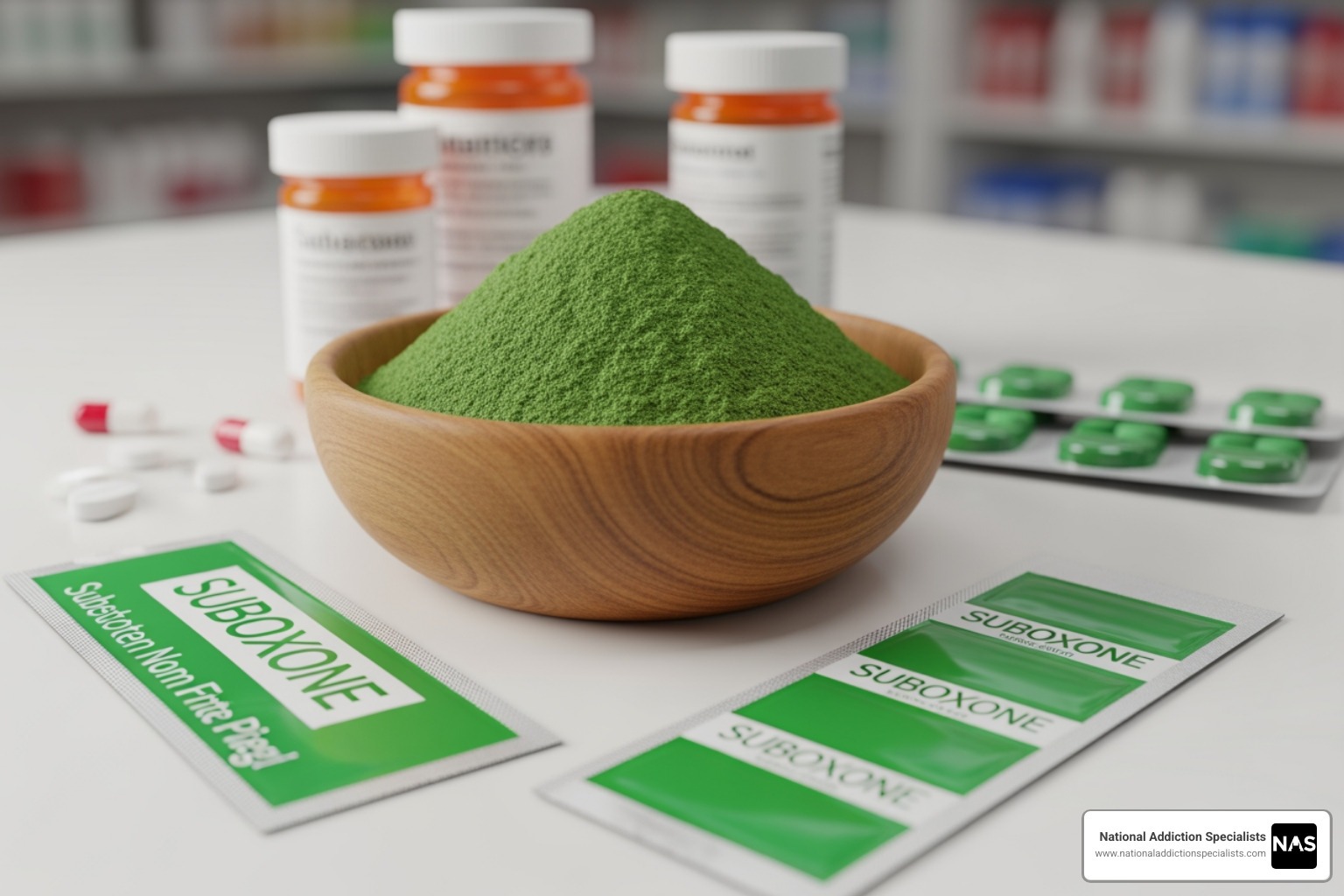
The short answer is a resounding yes. But how does it work? Suboxone is a combination of two medications: buprenorphine and naloxone.
Buprenorphine is a “partial agonist.” Think of your opioid receptors as a dimmer switch. A full agonist (like heroin) turns the light all the way up to a blinding 100%. A partial agonist like buprenorphine turns the light up to about 40-50%—just enough to stop the withdrawal pain and cravings, but not enough to get you “high” or cause dangerous respiratory depression.
Research, including the Successful Management of Kratom Use Disorder With Buprenorphine-Naloxone, shows that this stabilization is the key to recovery. By switching from an unregulated plant with varying potency to a steady, FDA-approved medication, we can give your brain the stability it needs to heal.
In our Suboxone Treatment Complete Guide, we explain that Suboxone has a very high “affinity” for receptors. This means it sticks to the receptor like superglue, effectively blocking other substances (like kratom) from getting in. This “blocking effect” is a massive safety net against relapse.

How Suboxone Manages 7-OH and Kratom Withdrawal
A challenge we see today in Tennessee and Virginia is the rise of concentrated kratom extracts, specifically those high in 7-hydroxymitragynine (7-OH). These extracts are much more addictive than traditional leaf powder.
When patients ask, Does Suboxone Help Kratom 7-OH Withdrawal?, the answer is that it is often the most effective tool we have. Because 7-OH binds so tightly to opioid receptors, the withdrawal can be even more intense than standard kratom.
Standard Opioid Withdrawal usually peaks within a few days and is mostly over in a week. However, kratom withdrawal is unique—it can persist for up to three months. This long-term discomfort is why so many people fail when trying to quit cold turkey. Suboxone provides a bridge, managing those symptoms over the long haul so you can actually focus on your life instead of just surviving the day.
Clinical Evidence: Can Suboxone Help with Kratom Dependence?
We don’t just rely on “gut feelings” here; we look at the data. Several ISSUP research papers on Suboxone for Kratom have highlighted successful case reports where patients who failed every other method finally found success with buprenorphine.
One significant study found that 68% of patients receiving buprenorphine treatment for kratom use disorder tested negative for mitragynine after just four weeks. That is a massive success rate for a condition that is notoriously difficult to treat.
At National Addiction Specialists, we utilize Medication Assisted Treatment (MAT) because it is the gold standard. While some clinics have helped over 1,000 patients transition from opioids and kratom, we focus on the individual. Every person’s “kratom journey” is different, and the clinical evidence proves that a tailored Suboxone protocol is often the missing piece of the puzzle.
Dosing Strategies and Transitioning Safely
One of the most common mistakes people make is trying to “DIY” their transition. This can lead to precipitated withdrawal, which is essentially a “crash” where the Suboxone kicks the kratom off your receptors too fast, making you feel 10 times worse.
To avoid this, timing is everything. Most protocols suggest waiting at least 8 to 12 hours after your last kratom dose—or until you are in moderate withdrawal. We use the Clinical Opiate Withdrawal Scale (COWS) to measure exactly when it’s safe to start.
| Daily Kratom Intake | Estimated Suboxone Induction Dose |
|---|---|
| Low (<20g/day) | 2mg – 4mg daily |
| Moderate (20g – 40g/day) | 4mg – 8mg daily |
| High (>40g/day or extracts) | 12mg – 16mg daily |
Note: These are estimates. Always follow the specific plan provided by your provider.
Many of our patients prefer an At Home Detox via our telemedicine platform. This allows you to start your induction in the comfort of your own bed, with our medical team just a video call away to guide you through the Dosing guidelines for kratom withdrawal. After the initial induction, we enter the stabilization phase, where we fine-tune the dose until you have zero cravings and zero withdrawal symptoms.
Risks, Benefits, and Alternatives to Suboxone
While ** Can Suboxone Help with Kratom Dependence** is a question with a positive answer, it’s important to weigh the pros and cons.
The Benefits:
- Stability: You stop the “rollercoaster” of dosing kratom every few hours.
- Safety: You are taking a regulated, pharmaceutical-grade medication instead of a potentially contaminated plant.
- Success: Higher long-term recovery rates than “cold turkey.”
The Risks:
- Off-label use: While widely used by experts, the FDA has not officially “labeled” Suboxone for kratom specifically (it is approved for “Opioid Use Disorder”).
- Side effects: Some may experience headaches, constipation, or nausea.
- Dependence: You will develop a physical dependence on Suboxone. However, as we say in the industry, dependence is not the same as addiction. You can eventually undergo a slow, medical Suboxone Withdrawal or taper when you are ready.
The Alternatives: For those with very mild kratom habits, we might suggest Outpatient Detoxification using non-opioid supports like clonidine (for blood pressure and anxiety) or gabapentin. However, for those with heavy use or multiple failed quit attempts, Suboxone is usually the more robust choice.

Frequently Asked Questions about Kratom and Suboxone
Is Suboxone FDA-approved for kratom dependence?
Technically, no. The FDA approves medications for specific “indications.” Suboxone is approved for Opioid Use Disorder (OUD). Because kratom acts on opioid receptors, many addiction specialists (including us) treat kratom dependence as a form of OUD. This is called “off-label” use, and it is a very common and legal practice in medicine when the science supports it.
How long does kratom withdrawal last compared to opioids?
This is the “gotcha” of kratom. While heroin withdrawal is usually over in a week, kratom withdrawal can involve Post-Acute Withdrawal Syndrome (PAWS) that lasts for months. This includes lingering depression, “brain fog,” and fatigue. This is why specialized Kratom Treatment is so important—it’s a marathon, not a sprint.
Can I get Suboxone for kratom via telemedicine?
Yes! In 2026, telemedicine is one of the most effective ways to get help. If you live in Tennessee or Virginia, National Addiction Specialists can provide a What Is Suboxone consultation and a prescription entirely online. You don’t have to sit in a waiting room or take time off work.
Conclusion
Kratom dependence can feel like a trap, especially when you started using it to feel better. But you don’t have to stay stuck. At National Addiction Specialists, we’ve seen how the right medical support can change everything.
By combining telemedicine-based Suboxone treatment with counseling and a personalized recovery plan, we help you take your life back from the comfort of your home in Brentwood, Virginia Beach, or anywhere across Tennessee and Virginia. Whether you are struggling with traditional leaf powder or the newer 7-OH extracts, we have the tools to help.
Check out The Complete Guide to Suboxone Treatment Options to see which path is right for you, or visit our Insurance and Pricing page to see how we make recovery affordable by accepting Medicaid and Medicare.
Make an Appointment to Treat Addiction Please don’t hesitate. Make an appointment today. Make an Appointment
This article was medically reviewed by: Chad Elkin, MD, DFASAM is a board-certified addiction medicine physician, founder, and Chief Medical Officer of National Addiction Specialists, dedicated to treating substance use disorders. A Distinguished Fellow of the American Society of Addiction Medicine (ASAM), Dr Elkin currently serves as President of the Tennessee Society of Addiction Medicine (TNSAM) and has held various leadership roles within the organization. Dr Elkin chairs ASAM’s Health Technology Subcommittee and is an active member of its Practice Management and Regulatory Affairs Committee, State Advocacy and Legislative Affairs Committee, and other committees. He also serves on the planning committee for the Vanderbilt Mid-South Addiction Conference. Committed to advancing evidence-based policy, Dr Elkin is Chairman of the Tennessee Association of Alcohol, Drug, & Other Addiction Services (TAADAS) Addiction Medicine Council, which collaborates with the TN Department of Mental Health & Substance Abuse Services (TDMHSAS). He has contributed to numerous local, state, and national task forces, helping develop professional guidelines, policies, and laws that align with best practices in addiction medicine. His work focuses on reducing addiction-related harm, combating stigma, and ensuring access to effective treatment. Passionate about the field of addiction medicine, he remains dedicated to shaping policy and enhancing patient care.
Suboxone® and Subutex® are a registered trademark of Indivior UK Limited. Any mention and reference of Suboxone® and Subutex® in this website is for informational purposes only and is not an endorsement or sponsorship by Indivior UK Limited.